
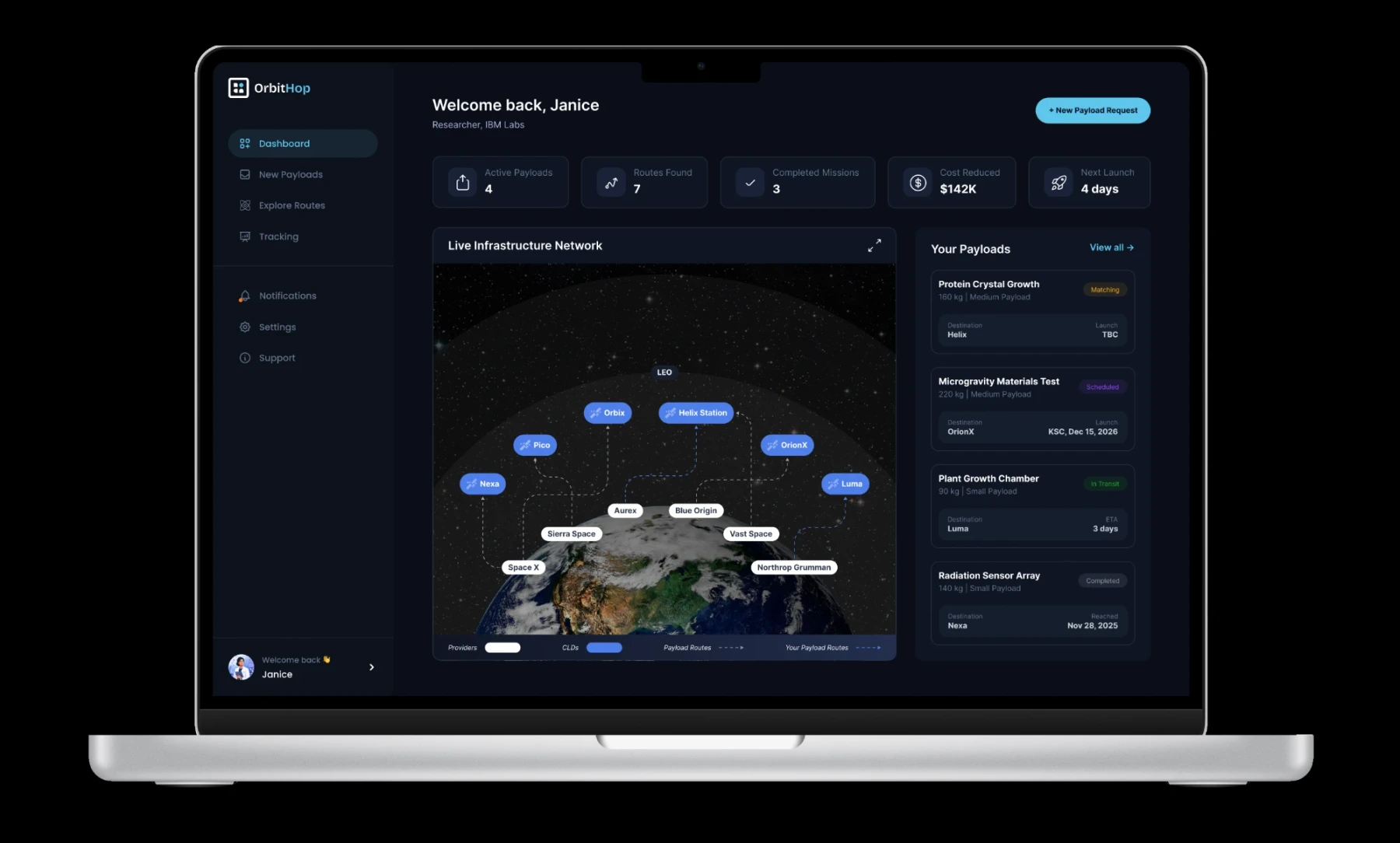
Strategic Context
NASA (the National Aeronautics and Space Administration) is the U.S. government agency responsible for the nation’s civil space program, aeronautics research, and space exploration — including operating the International Space Station (ISS) in low Earth orbit (LEO) since 1998. As the ISS approaches retirement around 2030, NASA is handing off LEO infrastructure to a new generation of commercially owned space stations — Commercial LEO Destinations, or CLDs — from companies like Axiom, Vast, and Starlab, while refocusing its own efforts on deep space exploration.
That handoff creates a coordination gap: NASA won’t own the infrastructure anymore, but it still needs to guarantee that science in orbit keeps scaling. Nobody currently owns the logistics layer connecting researchers, launch providers, and CLDs. OrbitHop is the strategy built to fill that gap — a shared-logistics marketplace for Low Earth Orbit.
The Challenge
Initial Brief
How might ISS and the National Lab build upon and scale the science and discovery both on station and in future LEO, and what forms of partnerships and logistics would need to be created to sustain that mission?
I spent the first phase deconstructing that brief — clustering keywords, branching out possible strategies, and pressure-testing them against expert feedback — before converging on a sharper question to build against:
Redefined Brief
How might we create a LEO ecosystem that expands science?
The macro shift
NASA is transitioning from owning a single, dedicated orbital outpost to orchestrating a decentralized, commercial economy — a fragmented marketplace of Commercial LEO Destinations (CLDs) and private launch providers with no shared operating layer between them. OrbitHop’s premise: NASA doesn’t need to own more infrastructure — it needs to become the neutral software and logistics platform that makes the infrastructure that already exists actually usable.
The diagnostic: an invisible capacity problem
High Cost
Dedicated missions are extremely expensive, and pricing across providers remains highly fragmented.
Long Waits
Academic and commercial researchers face severe delays, often waiting years to reach orbit.
Wasted Space
Rockets frequently launch with unused mass and volume capacity that could easily accommodate smaller payloads.
Siloed Infrastructure
Stations, launchers, and satellites lack standardized interoperability and logistics sharing.
Space infrastructure is highly active but critically underutilized. Unused capacity remains invisible.
The Solution: The Flexport of Space
The analogy is direct: Uber Freight and Flexport match half-empty trucks with cargo on Earth, eliminating deadhead miles. OrbitHop does the same thing for space.
Uber Freight / Flexport — On Earth
Matches half-empty trucks with cargo to eliminate deadhead miles and optimize global shipping.
OrbitHop — In Space
Payloads no longer book dedicated missions. Instead, they "hop across available space infrastructure" to reach their destinations affordably.
The Mechanism
We don't own the rockets or space stations. We build the software layer that bundles payloads and buys up unused capacity, allowing science to hitchhike to space.
Strategy: Dedicated vs. Shared Logistics
Cost
Prohibitive and fragmented across providers
Highly subsidized and predictable
Access Time
Years-long delays to secure a launch
Frequent, rapid launch cycles
Payload Capacity
Wasted and underutilized on every launch
Optimized and bundled across payloads
Integration
Siloed and proprietary interfaces
Standardized interfaces and safety protocols across all providers
How It Works: A 3-Layer Journey
Payload Request Submission
Users input their payload's size, weight, and orbit flexibility directly into the dashboard.
Opportunity Scanner & Ride Matching Engine
OrbitHop dynamically scans upcoming launches and groups payloads into optimized, shared rides to maximize capacity.
Hitchhiking on Commercial Rockets
Payloads are safely delivered to LEO stations (CLDs), where breakthrough experiments run collaboratively.
↺ Runs as a continuous loop — each cycle feeds the next
The marketplace orchestrator
OrbitHop sits between two sides of the market, acting as the LEO governance layer — connecting, matching, and standardizing interfaces, scheduling, and safety protocols across both.
Providers
Space transportation and logistics companies contribute the physical infrastructure — rockets, tugs, return capsules.
Users
Researchers, startups, and nations access space via shared, highly affordable routes.
Supply Side: The Infrastructure Backbone
Stage 1 — Primary Launch
SpaceX, Blue Origin, Northrop Grumman: leveraging the frequent cadence and vast capacity of vehicles like Falcon 9 to enter LEO affordably.
Stage 2 — Last-Mile Tugs
D-Orbit & Bellatrix Aerospace: vital "space tugs" completing precision delivery, moving payloads from standard orbits to specialized destinations.
Stage 3 — On-Demand Return
Inversion & ATMOS Space Cargo: ensuring high-value science experiments and manufactured goods return safely from LEO to Earth.
↺ Runs as a continuous loop — each cycle feeds the next
Demand Side: Opening Space to Everyone
Researchers
Access rapid microgravity testing without requiring full mission budgets.
Startups
De-risk commercial hardware demonstrations with frequent launch cycles.
Universities
Empower student projects and academic labs with heavily subsidized rideshare slots.
Nations
Provide emerging space programs a turnkey, accessible logistics solution to LEO.
Lower cost = more participants. Better utilization = less waste.
Business Model: Cost-Sharing, Not Profit Margin
OrbitHop operates on a cost-recovery and subsidy model to maximize accessibility, rather than a traditional profit margin.
1. Bulk Purchases — The Anchor
NASA acts as the anchor buyer, using its scale to purchase unused commercial rocket capacity in bulk at a steep wholesale discount.
2. Commercial Fares — Cost-Recovery
Offers "seats" to commercial startups at a fair market cost, recovering the platform's operational expenses.
3. Academic Subsidies — Accessibility
Heavily subsidizes the remaining tickets for universities and researchers, removing traditional financial barriers to entry entirely.
NASA’s true return on investment
The ROI isn’t a profit margin — it’s stimulating the broader space economy.
Maximizes Science
Eliminates financial hurdles, dramatically increasing the sheer volume of U.S. experiments flown.
Stimulates Commercial LEO
Provides private space stations (CLDs) and launch providers a steady, reliable stream of diverse customers and revenue.
Maintains Leadership
Positions NASA as the central governance organization, ensuring shared standards, safety, and integration across a fragmented global market.
The Orbital Innovation Flywheel
Each turn of the flywheel compounds into faster scientific innovation.
Lower Barrier to Entry
Subsidized and shared rides bring the cost of reaching orbit down.
More Participants & Payloads
Startups, universities, and nations join — capacity that used to sit empty now has demand.
Better Infrastructure Utilization
Less wasted rocket mass on every launch, across every provider.
Stronger Commercial Partnerships
Steady, predictable revenue for CLDs and launch providers funds the next round of capacity.
↺ Runs as a continuous loop — each cycle feeds the next
Product screens
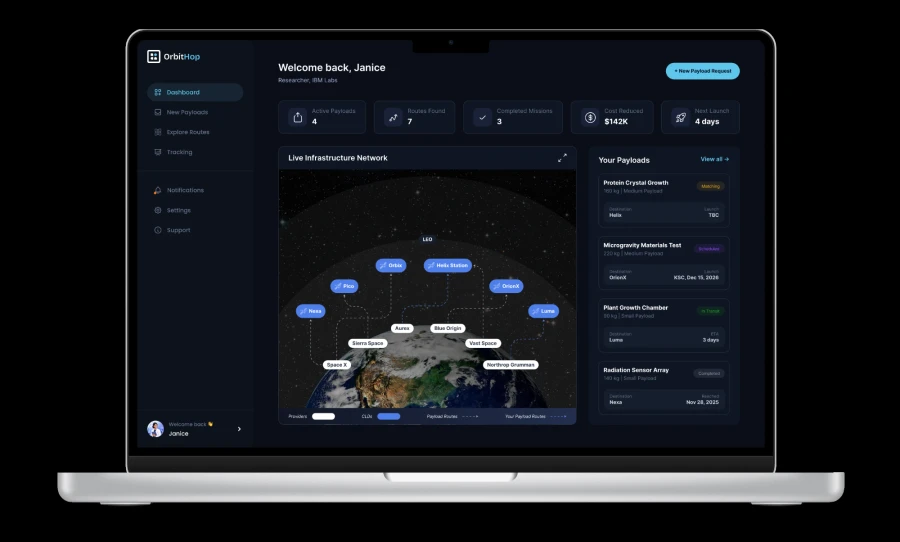
Dashboard
Active payloads, routes found, and a live map of providers and Commercial LEO Destinations.
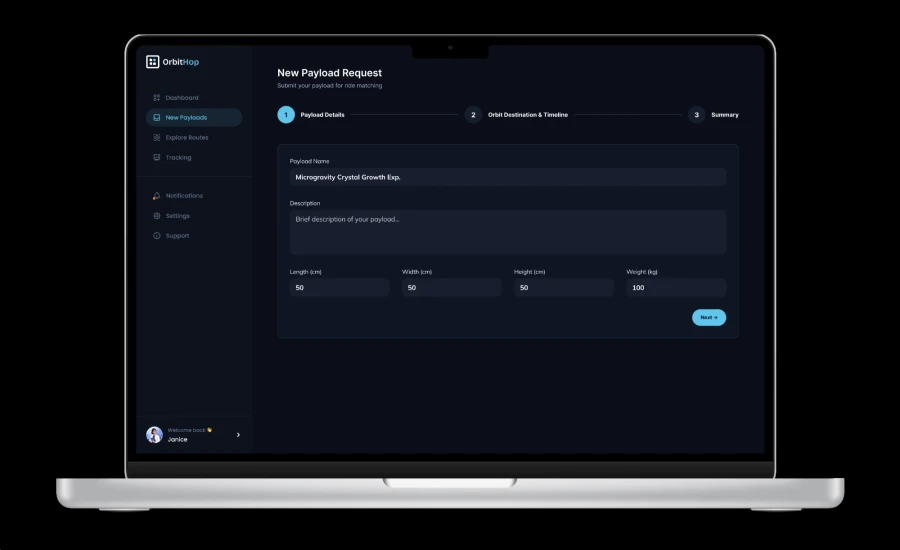
New Payload Request
Step 1 of 3 — payload name, description, and dimensions submitted for ride matching.
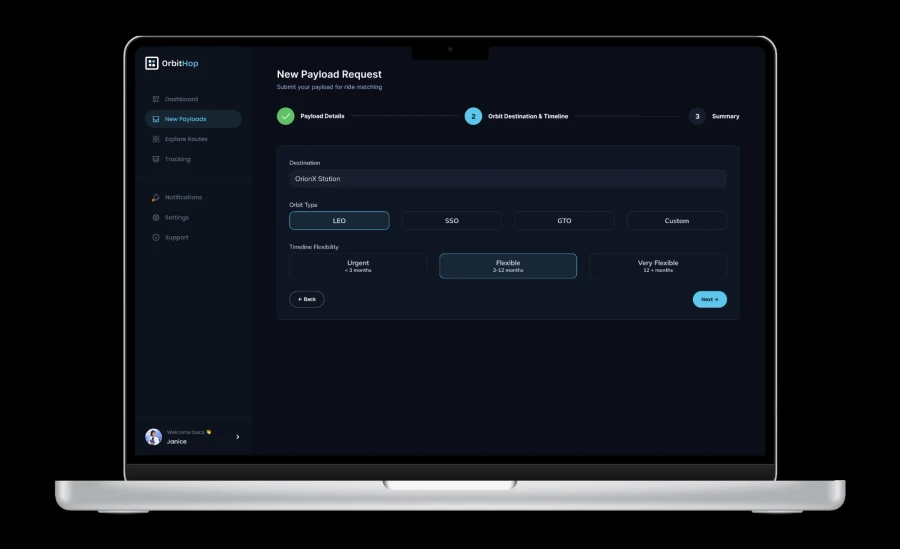
Orbit Destination & Timeline
Step 2 of 3 — destination, orbit type (LEO/SSO/GTO/Custom), and timeline flexibility.
Click to view images
Outcome & Impact
OrbitHop makes the case that NASA doesn’t need to own more infrastructure to keep science scaling in LEO — it needs to own the logistics layer that connects everyone else’s. That’s the “in transit” bridge between Earth-based research and the orbital economy: without it, as the strategy framework puts it, science cannot scale.
OrbitHop
Bundling the future of space exploration.