00 Business Strategy & AI
LIFEVERSE
Manulife's Digital Passport for Health & Wealth

Strategic Context
Manulife Financial Corporation is a Canadian multinational financial services company providing insurance, wealth management, and financial advice to individuals, businesses, and institutions worldwide — operating as Manulife in Canada, Asia, and Europe, and as John Hancock in the United States. Founded in 1887, it’s one of the largest insurers and asset managers in the world, built on a business model designed around selling standalone financial products.
That model has a structural problem: most customers only ever interact with Manulife through an employer benefits plan they didn’t choose, engagement is almost entirely reactive — a claim, a renewal — and its health and wealth product lines operate in near-total isolation from each other, even though the research shows they’re inseparable in a customer’s actual life. This project develops the strategy to close that gap: LIFEVERSE, a hyper-personalized digital passport that repositions Manulife from a transactional insurer into a lifelong health-and-wealth partner.
The Challenge
Manulife’s brief was deliberately open-ended:
The Brief
How might Manulife reimagine its health and wealth ecosystem to become a trusted lifelong partner for Canadians — moving beyond traditional insurance and financial products — over the next decade?
A reality check
Canada is ageing faster than its financial and healthcare systems are adapting to it.
2026
the year Canada officially becomes a 'super-aged' nation
0%
of Ontario will live with a serious disease by 2040
0%
of Canadians cannot afford to retire on time
Canada’s longevity paradox
Longevity doesn’t happen automatically — living longer isn’t the same as living well.
1 in 5
Canadians will be over 65 by 2026
0%
of life is spent in poor health by 2040
0%
face financial insecurity as they age
Research & Insights
Needfinding: validating assumptions with reality
We ran primary interviews to pressure-test our early assumptions against how Canadians actually behave — not how they say they’d like to behave.
James
Reactive by default
- Only visits the doctor when 'something is wrong'
- Financial stress is directly causing sleep loss and physical stress
- No RRSP or TFSA contributions in 3 years
Marcus K.
Tracks data, ignores it
- Skips annual physicals — "I feel fine"
- No preventative care, despite tracking fitness data daily
- Afraid of raising his lifestyle cost by engaging with insurance
Sarah L.
Everyone but herself
- Prioritizes family dental and vision, skips her own physicals
- RRSP contributions paused since her second child
- Cost of living is her #1 financial anxiety
Priya T.
Quietly afraid
- Financially engaged, but deeply uncertain about the future
- Cannot predict rising healthcare costs against her savings
“My biggest fear is outliving my savings, especially with raising healthcare costs that I can't predict.”
Three gaps in the Canadian experience
Over-Reliance on Employer Plans
Most Canadians' only touchpoint with Manulife is a benefits plan they didn't choose and rarely think about outside of a claim.
Lifestyle Changes Are an Afterthought
Health and financial habits are tracked separately, if at all — nothing connects a daily choice to a long-term outcome.
Low Engagement with Carriers
Interaction is transactional and rare: sign up once, file a claim occasionally, otherwise invisible.
Our challenge is not just adding years to life, but adding life to those years.
The strategic insight
How Might We
How might Manulife empower Canadians to tangibly visualize the connection between their daily physical health and their long-term wealth, so they can take proactive action today?
The data backs the connection up directly: the cost of an early intervention nudge is consistently smaller than the cost of a reactive medical claim. Better health correlates with 14 fewer sick days a year; 20% of life spent in poor health accelerates the depletion of retirement savings; and financial stress measurably increases the risk of chronic disease. Health and wealth aren’t two separate ledgers — they’re one feedback loop.
Strategy: The Paradigm Shift
To be a trusted lifelong partner, Manulife has to measure and manage both domains simultaneously — which means rebuilding the relationship from the ground up, not adding another app on top of the old one.
Focus
Selling isolated products
Sustaining health-span and wealth-span
Data
Siloed, reactive claims data
Interconnected lifestyle, health, and financial data
Intervention
Reactive payout upon illness or death
Proactive nudges based on predictive AI
Engagement
Transactional, low frequency
Daily behavioral integration and micro-habits
The Solution: Introducing LIFEVERSE
The Manulife Digital Passport — a hyper-personalized, AI-driven platform. Your report card for life. A national identity for well-being.
It’s built as an embedded, frictionless ecosystem: the system relies on automated data flow, requires zero manual data entry from the user, and meets people exactly where they already are — in their banking app, their fitness tracker, their employer benefits portal.
- Invisible backend: tracks daily habits to build dual Health and Wealth scores incrementally
- Proof of health & wealth: a simple front-end UI hiding genuinely massive data complexity
- Proactive insights: pings users with preventative support and resources before crises occur — secured by consent-based API tokenization, FIDO2/OAuth OTP, and blockchain privacy
Anatomy of the dual score
Health Score
Rooted in National Institute of Ageing (NIA) data
- Physical & mental health — movement, nutrition, screenings, preventative care — 70%
- Social engagement — volunteering, community, family milestones — 30%
Wealth Score
Savings rate, debt-to-income ratio, retirement readiness, check-in frequency
- Financial habit tracking — 100%
Try it — drag the slider
Physical Health Down. Financial Health Down.
Health and wealth aren't tracked as two separate numbers — they move together. Drag your physical & mental health score and watch the wealth score respond, modeled on the correlation this research surfaced.
Strong physical health is keeping sick days low and retirement savings on track.
Modeled directionally on this case study's cited research — better health correlates with ~14 fewer sick days annually; roughly a fifth of life spent in poor health accelerates the depletion of retirement wealth; and financial stress measurably increases the risk of chronic disease. Illustrative, not a literal Manulife scoring formula.
Hyper-personalized predictive care, in action
The Trigger
AI detects a sudden drop in a user's Wealth Score — an unexpected expense, a market shift.
The Prediction
Historical data shows this level of financial stress predicts a 10-point Health Score drop within months, driven by sleep loss and cortisol spikes.
The Intervention
Manulife proactively reaches out with a complimentary financial advisor session and preemptive CBT mental health counseling.
↺ Runs as a continuous loop — each cycle feeds the next
“Just checking in on you, Sarah 👋 — we see your wealth score has changed. To protect your overall well-being, here is two months of complimentary access to a financial advisor and preemptive CBT mental health counseling.”
Meeting Canadians at every life transition
- Goal
- Acquire users while they have zero financial capital but high human capital — the stage traditional banks and insurers both ignore.
- The Gap
- Financial literacy, basic health habit formation, and early tax planning are never taught, so most Canadians enter adulthood without a working model for any of it.
- The Strategy
- A free Starter Wealth Account and zero-touch onboarding — every healthy habit and small deposit quietly builds the Passport from day one.
- Goal
- Build financial and physical resilience — the goal isn't just "saving for a house," it's not being one bad break away from a total reset.
- The Gap
- This demographic is time-poor, stressed by debt, first homes, marriage, and kids, and misses proper coverage because of administrative exhaustion, not disinterest.
- The Strategy
- The Invisible Underwriter: a dual-engine digital passport that bridges employer benefits and personal accounts automatically, with dynamic, life-stage-aware coverage instead of one static policy.
- Goal
- Navigate the 'retirement blind spot' — people plan for a date (age 65) rather than a duration (how long they'll actually live).
- The Gap
- Group benefits are no longer the primary driver at this stage; hyper-personalized retirement and decumulation planning is, and most systems aren't built for it.
- The Strategy
- Dynamic decumulation, using real-time biometric and health data to model spend-down rates that actually match a person's likely healthspan.
An integrated ecosystem
Phone Application
A single integration point, built like the Apple ecosystem — one login, every score.
Healthcare Systems
Clinics, hospitals, and dentists feed preventative-care signal directly into the Health Score.
Financial Institutions
Wealth management and banking partners plug into the same passport, not a separate one.
Wearables & Trackers
Apple Health, Fitbit, and other devices supply the invisible backend with zero manual entry.
The final prototype
Onboarding, the dual-score dashboard, merchant rewards, and family sharing — the finished product, screen by screen.

LIFEVERSE
The infinity mark — health and wealth as one continuous loop.
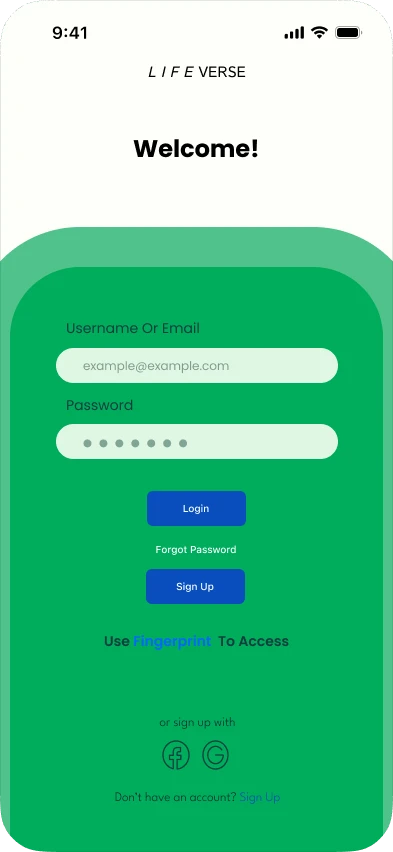
Welcome
A single, portable login — not another employer portal.

Your Report Card for LIFE
Canadians' Trusted Partner — the passport's opening statement.
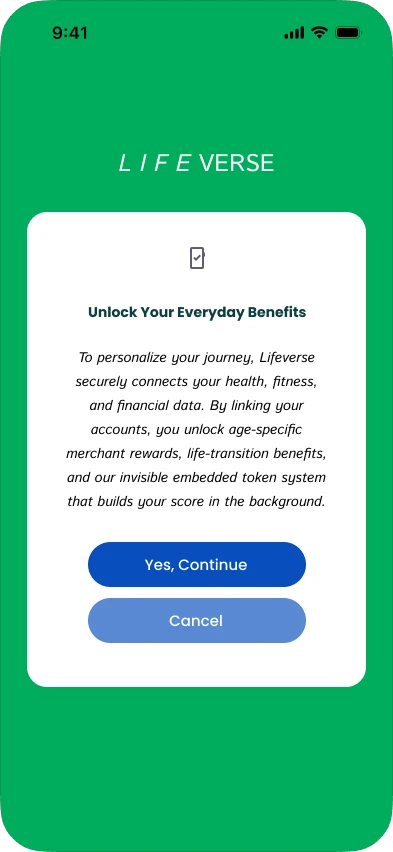
Consent, Upfront
What LIFEVERSE connects, why, and what it never touches — before anything syncs.
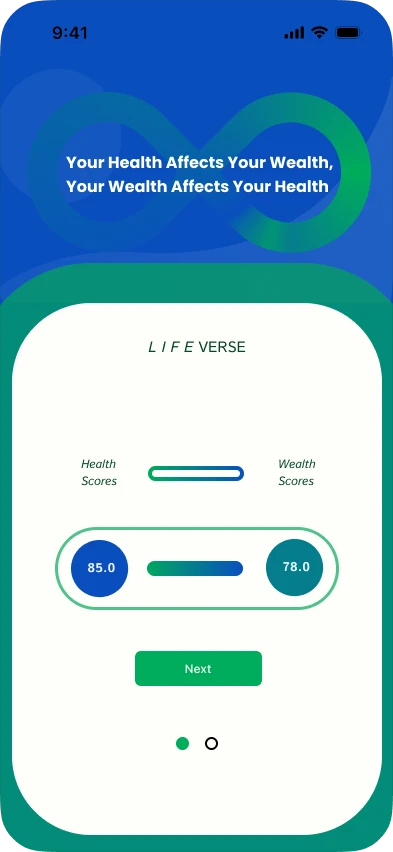
The Core Insight
The thesis stated as onboarding copy: health and wealth move together.
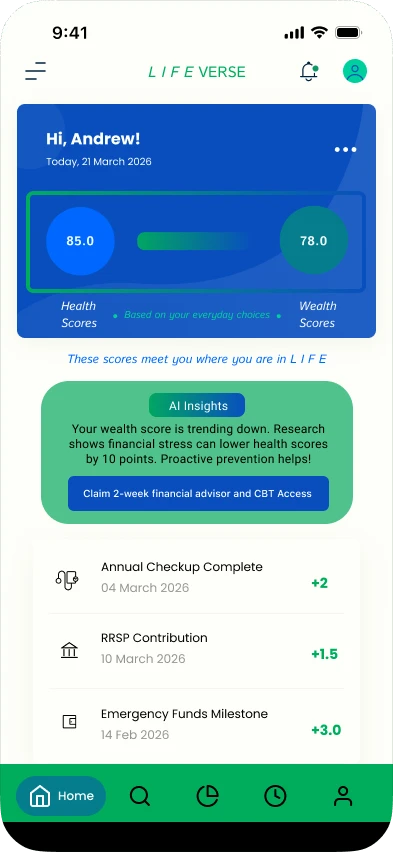
Home Dashboard
"Hi, Andrew!" — dual scores, an AI insight, and recent activity at a glance.
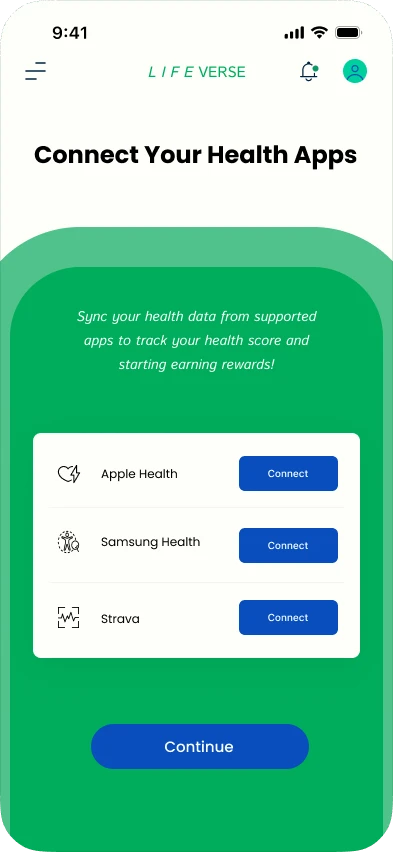
Connect Your Data
Apple Health, Samsung Health, Strava — the invisible backend starts here.
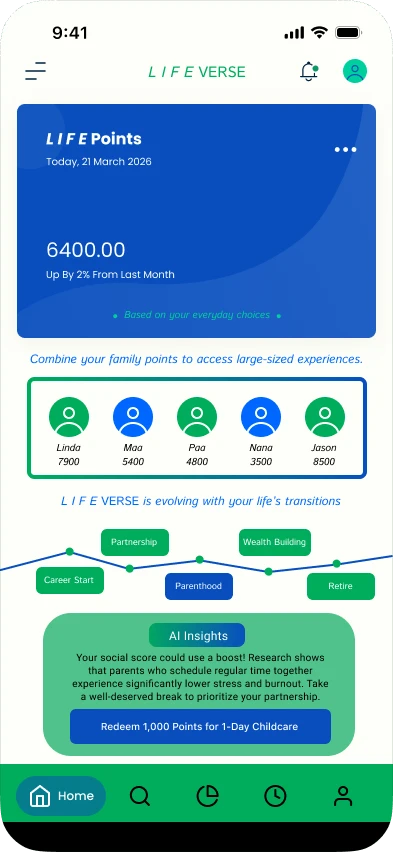
LIFE Points & Family Sharing
Embedded tokens, redeemable at life-stage merchants, shareable with family.
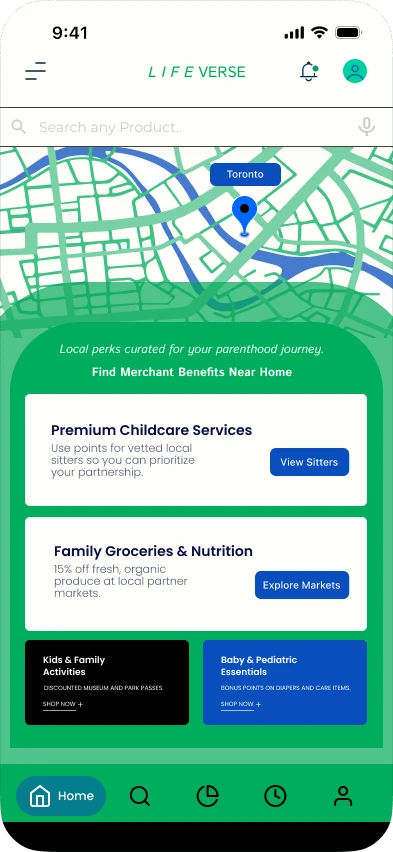
Merchant Discovery
Tokens redeemed nearby — childcare services, grocery partners, everyday relief.
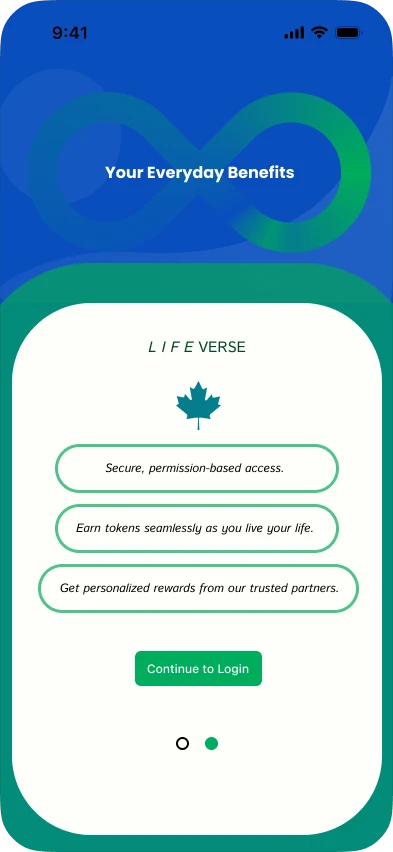
Everyday Benefits
Secure, permission-based access — earn tokens simply by living your life.
Click to view images
Business Model: A Multi-Sided Market
The Users
Gain hyper-personalized guidance, rewards, and better longevity — without lifting a finger to manage it.
Life-Stage Merchants
Gain access to highly targeted demographic segments — childcare services for new parents, NORC programs for seniors.
Care Providers & Advisors
Therapists, specialized clinics, and financial advisors gain qualified, proactive leads instead of cold outreach.
Manulife
Saves money on claims, earns new revenue from merchants, and builds a platform people actually want to open daily.
Three revenue streams
Merchant Ecosystem Fees
Life-stage merchants — gyms, therapists, financial advisors — pay subscription or lead-generation fees to reach Manulife's 7M+ users at exactly the moment they need them most.
Data Is Everything
Aggregated health and wealth data sharpens Manulife's underwriting accuracy and triggers perfectly timed, needs-based offers at key life milestones.
Massive Claims Reduction
Proactive AI nudges prevent severe physical and mental health crises before they happen, drastically reducing long-term disability and medical payouts.
Designing for support, not punishment
Tracking scores can cause anxiety — a falling score might discourage users and do real harm. We designed the system around three guardrails:
No Penalties
The system never punishes a falling score with higher premiums. A drop triggers support, never a price increase.
Grace Periods
Built-in AI recognizes major life events — job loss, depression, bereavement — and pauses gamification to activate pure support mode.
Anti-Fraud Measures
Robust data validation prevents users from manipulating the system to extract free services.
Outcome & Impact
Rollout: build, scale, embed
Years 1–2
Build & Validate
Alpha and Beta exclusively for existing Manulife Group Benefit members; onboard first-tier merchant partners to prove the ecosystem's value.
Years 3–5
Scale & Monetize
Launch AI-powered predictive nudges, expand the merchant network, and enable family and community sharing — hitting the multi-sided market's tipping point.
Years 6–10+
Embed & Dominate
Deep API integrations with health records and major banks; a seamless, invisible platform transitioning from corporate app to national identity.
Projected growth
250K–500K
1–2 yrs
1M–2M
3–5 yrs
3M–5M
6–10+ yrs
1,000–3,000
1–2 yrs
5,000–10,000
3–5 yrs
15,000–25,000
6–10+ yrs
3–5
1–2 yrs
10–20
3–5 yrs
30–40
6–10+ yrs
$2M–$5M
1–2 yrs
$10M–$25M
3–5 yrs
$40M–$75M
6–10+ yrs
+10
1–2 yrs
+30
3–5 yrs
+50
6–10+ yrs
The 10-year backcast
Speculative — Backcasting from 2036
By 2036, the Manulife Passport becomes a Canadian national identity for well-being.
By acknowledging that health and wealth are inextricably linked, the Manulife Digital Passport redefines the role of an insurer for the next decade — for Manulife, a shift from a commoditized, reactive safety net to a daily, high-engagement lifestyle platform powered by network effects; for the healthcare and financial system, a reduced systemic burden through preventative care; and for the customer, confidence, independence, and dignity — a trusted, invisible guide that turns complex health and wealth decisions into small, daily choices.