
Strategic Context
CareGrid began as UX research and systems design work: architecting the foundational concept and business value proposition for an AI-enabled care coordination platform for neurodiverse families, and translating deep qualitative research into actionable stakeholder journey maps to reduce caregiver burnout. The concept was accepted into the Base44 Accelerator, ranking in the Top 44 worldwide.
Overview
CareGrid is an AI-powered social infrastructure designed to decentralize care for neurodiverse families. By bridging fragmented medical, educational, and home environments into a cohesive ecosystem, it transforms the invisible economy of caregiving into a tangible, community-driven network that proactively supports continuous behavioral needs.
The Problem Space: Fragmented Care
The scale of neurodiversity
A growing population requiring systemic support:
- 1 in 36 children diagnosed with ASD (CDC, 2023)
- 11% of children affected by ADHD globally
- 20% estimated neurodivergent population
- $268B in annual autism-related costs in the U.S.
1 in 36
children diagnosed with ASD (CDC, 2023)
11%
of children affected by ADHD globally
20%
estimated neurodivergent population
$268B
in annual autism-related costs in the U.S.
What is neurodiversity?
Natural variation in brain, cognition, sensory processing, and behaviour, including Autism Spectrum Disorder (ASD), ADHD, dyslexia and learning differences, Down syndrome, and sensory processing disorders.
Why this project?
From personal experience to systemic observation, the journey to CareGrid is rooted in the reality of neurodiverse caregiving:
- Lived experience: perspective as a sibling to a neurodiverse individual and as a vocational trainer
- Observed systemic gaps: fragmentation in support systems, education, and healthcare access
- Economic invisibility: care work is essential yet economically invisible and unrecognized
- Challenging productivity: neurodiversity challenges traditional definitions of productivity and contribution
- Undervalued economy: the care economy is systemically undervalued, despite being the bedrock of society
Emotional and temporal labour
The invisible workload carried by caregivers of neurodiverse individuals:
- Emotional labour: regulating the child’s emotions while suppressing their own stress, anticipating needs to prevent meltdowns, and providing calm during behavioral crises
- Temporal labour: hours spent on routines, therapies, and special education advocacy; unpredictable interruptions to work and personal time; managing the logistics of a neurodiverse care ecosystem
Emotional Labour
Regulating the child's emotions while suppressing their own stress, anticipating needs to prevent meltdowns, and providing calm during behavioral crises.
Temporal Labour
Hours spent on routines, therapies, and special education advocacy; unpredictable interruptions to work and personal time; managing the logistics of a neurodiverse care ecosystem.
Mapping Systemic Failures
Stakeholder ecosystem
Concentric circles of care, showing how support radiates outward from the individual to societal systems:
- Inner circle: neurodiverse individual and family caregivers
- Middle circle: education, therapy, and community support
- Outer circle: policy, insurance, healthcare, and society
Inner circle
Neurodiverse individual and family caregivers
Middle circle
Education, therapy, and community support
Outer circle
Policy, insurance, healthcare, and society
Pain points identified
Top challenges cited across 20 in-depth caregiver interviews:
Constant vigilance and regulation fatigue leading to burnout
A "cliff-edge" after diagnosis with no clear roadmap
Deep fear about long-term care and independence
High costs of private therapies and specialized support
Educational environments refusing sensory needs
Inability to track behavioral triggers over time
Lack of a community that understands without judgment
Why existing systems fail
- Fragmented services: medical, educational, and therapeutic systems operate in silos, forcing parents to be the only bridge
- No behavioural continuity: context is lost between home and school
- Overwhelmed caregivers: high burnout without respite or tools
- No structured training: parents left to figure it out through trial and error
- No centralized data: behavioral insights scattered across paper logs, memory, and providers
- No emotional load recognition: caregiving labor treated as non-existent in economic and medical assessments
Architecting the Care Ecosystem
A living care infrastructure designed specifically for neurodiverse families, integrating data, community, and support. The platform runs as a continuous loop:
- Behaviour logging (input): captures real-time data on mood, sleep, meltdowns, and daily wins
- AI companion (insight): analyses logs to identify patterns, predict triggers, and suggest routines
- Training platform (knowledge): delivers age-specific guidance based on behavioural needs
- Community (connection): peer support, shared strategies, and emotional validation
Behaviour logging
Input — captures real-time data on mood, sleep, meltdowns, and daily wins
AI companion
Insight — analyses logs to identify patterns, predict triggers, and suggest routines
Training platform
Knowledge — delivers age-specific guidance based on behavioural needs
Community
Connection — peer support, shared strategies, and emotional validation
↺ Runs as a continuous loop — each cycle feeds the next
Key Features
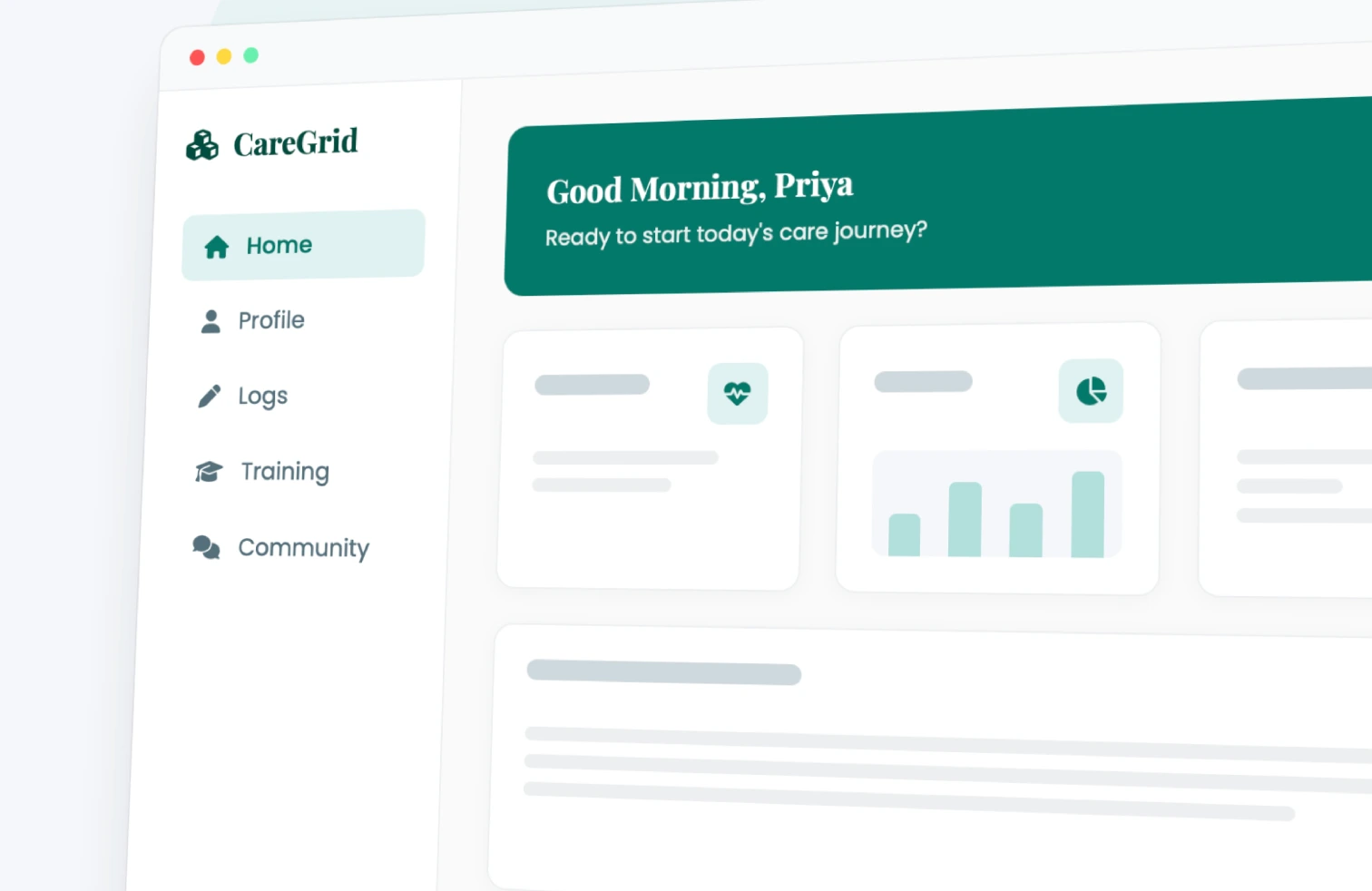
- Home dashboard: quick actions, care economy metrics, and recent activity at a glance
- Care profiles: diagnosis details, communication needs, special interests, and sensory preferences
- Daily mood and behaviour log: tracks mood, energy, sensory comfort, sleep, meltdowns, and more to surface patterns and wins
- Goals and progress tracking: turns long-term goals like independence into measurable milestones
- AI Care Companion (agentic AI): analyzes logs to identify patterns and triggers and offers proactive support
- Daily schedule builder: routines generated from real-time mood, energy, and sensory data
- Behaviour pattern reports: turn raw logs into insights so caregivers can anticipate needs rather than react to crises
- Parent training platform: age-based curriculum from early signs (2–6) to transition skills (16–18)
- Peer community: a judgment-free space for shared experiences and support
- Care log dashboard: visualizes care hours, emotional load, daily wins, and resilience to validate the caregiver’s invisible labor
Try it live
The CareGrid Intervention
Economic reframing: Asset-Actifs
Moving beyond “burden” to recognize the foundational economic value of care. Families are:
- Agents of maintenance: active maintainers of human infrastructure and societal stability
- Value-producing entities: care work produces resilience and future capability, and reduces long-term state dependency
- Holders of emotional-temporal assets: time, patience, and emotional regulation are finite, valuable resources
Agents of Maintenance
Active maintainers of human infrastructure and societal stability.
Value-Producing Entities
Care work produces resilience and future capability, and reduces long-term state dependency.
Holders of Emotional-Temporal Assets
Time, patience, and emotional regulation are finite, valuable resources.
Social and economic impact
By shifting care from an invisible burden to a visible, data-driven economy, CareGrid reduces burnout, enables early intervention, supports independence, builds community resilience, makes care visible, and validates caregiving as productive economic activity.
Implementation roadmap
2026
Prototype
Core UI/UX, mood and behavior log, profile system
2026
Pilot program
Beta launch with 50 families, community moderation, feedback loop
2026
AI personalization
Agentic AI, predictive scheduling, advanced pattern recognition
2027+
Policy integration
Health insurance partnership, care hour certification, public infrastructure tie-in
Future vision
What if care was recognized as economic value? What if families were seen as essential workers in the care economy?