
02 Social Innovation & Platform Strategy
ORIGN
A Direct-to-Artisan Marketplace & Cultural IP Platform
Strategic Context
India’s craft economy is one of the oldest living creative industries in the world, and one of the most regionally rooted. Kolhapuri chappals come from Kolhapur in Maharashtra, Bandhani from Kutch in Gujarat, dupattas from Punjab. Each tradition is a body of knowledge — techniques, patterns, motifs — held by families and clusters of artisans and passed down over generations.
That knowledge is now being commercialised by almost everyone except the people who hold it. Global brands borrow motifs without credit or compensation. Artisans sell through layers of middlemen who keep the margin. Most have little access to technology or to customers directly, and fewer young people are carrying craft forward. The result is a slow loss of both livelihoods and living heritage.
ORIGN is the strategy built to reverse that: a direct-to-artisan marketplace and cultural IP platform that connects artisans straight to buyers, protects their designs, and gives them the tools to compete on their own terms. It is built around provenance — where a craft comes from, and who made it.
The idea
ORIGN is rebuilding the artisan economy through fair access, transparency, and cultural protection.
The Problem
When heritage is borrowed without credit
The clearest symptom is cultural appropriation at global scale. When Prada’s sandals drew sharp criticism in India for echoing the Kolhapuri chappal, it made visible a pattern that repeats across categories: the design travels, the credit doesn’t.
Footwear
“Prada sandals”
Kolhapuri chappal — Kolhapur, Maharashtra
Textiles
“Scandinavian scarves”
Dupatta / chunni — Punjab
Prints
“Psychedelic prints”
Bandhani — Kutch, Gujarat
The ecosystem failure beneath it
Appropriation is only the visible event. Looking below the waterline with the Iceberg Model shows a layered failure — economic, operational, technological and generational — that no single fix would resolve.
Above the surface
Events
What we see
- IP theft and cultural appropriationGlobal brands use Indian motifs without credit or compensation.
Below the surface
Patterns
What keeps recurring
- Economic exploitationMiddlemen capture the margin while fast fashion pushes prices down.
- Lack of direct access to customersArtisans rarely reach the people who buy their work.
Structures
What shapes the patterns
- Operational barriersLogistics, order management and quality consistency are hard to run from a workshop.
- Tech barriersLittle digital infrastructure or know-how to sell online.
Mental models
What we quietly believe
- Generational declineFewer young people are choosing to carry craft forward.
- “Handmade should be cheaper”Buyers expect handmade work to cost less than mass production, undervaluing the skill.
Research & Insights
29 interviews with artisans and consumers grounded the work. Each group was looked at through the same three lenses: what hurts, what is needed, and what keeps people going.
0
interviews across artisans and consumers
0
stakeholder personas mapped
0
lenses for reading each side: pains, needs, contentment
Artisans
Pains: pressure from fast fashion, middlemen who suppress pay, no tech infrastructure. Needs: future security, decent pay, exposure, a clearer understanding of the system. Contentment: passion for the craft and preserving heritage.
Consumers
Pains: doubt about quality, authenticity and pricing. Needs: best value for money and trust in quality. Contentment: authentic handcrafted products, supporting local artisans, and a good experience.
Five personas, one marketplace
Artisan
Primary seller
- Low tech access
- Needs fair pricing
- Wants protection against design theft
Cultural Consumer
Story-led buyer
- Wants authentic, story-rich products
- Values provenance, customization, and maker connection
B2B Buyer
Boutique · Retailer · Designer
- Needs bulk production, quality consistency, and reliable logistics
Institutional Buyer
NGO or institution
- Needs traceable impact and ethical sourcing
International Designer
Collaborator
- Interested in fusion crafts, licensing patterns, and ethical co-creation
Strategy
Two missions, held in tension
External mission — systems thinking
Rebuild the economic and cultural ecosystem of Indian artisans: direct access to global buyers, fair income, legal protection, and sustainable growth opportunities.
Internal mission — design thinking
Use ethnographic research, service design, and innovation frameworks to reimagine the artisan economy with empathy, systems mapping, cultural justice, and technology accessibility.
Critical thinking sits between the two.
A blue ocean: the full-stack craft ecosystem
Most marketplaces compete on listings. ORIGN positions itself where four things meet, and wraps them in a full-stack ecosystem of legal support, logistics, design training, and democratized licensing.
- Craft
The artisans, techniques and materials that everything else exists to sustain.
- Technology
Low-tech-first onboarding, direct commerce and tokenized payments that open up global access.
- Legal Protection
Design ownership, timestamping and ethical licensing, so motifs can't be taken without credit.
- Cultural Storytelling
Maker profiles and provenance that put the story of every piece front and centre.
Four frameworks at work
Blue Ocean Strategy
Expand beyond today's artisan sellers and craft buyers to designers, B2B and institutional buyers, and build the legal, logistics and training layers around the craft.
Disruptive Innovation
Replace the middleman-led chain with direct-to-consumer and direct-to-business sales.
Social Innovation
Treat fair income, cultural protection and youth participation in craft as the product, not a side effect.
Reverse Innovation
Design for the lowest-tech artisan first, with mobile onboarding units, temporary micro internet cafés, assisted profiles and offline operations.
The Platform
What ORIGN solves
For artisans
Fair income through direct-to-consumer and direct-to-business sales; on-ground onboarding that builds their profiles for them; legal and IP protection; training in modern design trends; and simple logistics and order management.
For buyers
Authenticity and transparent provenance, custom orders placed directly with artisans, and verified reviews and quality standards.
For designers
Easy, ethical licensing of motifs and patterns, and direct collaboration channels with the artisans who own them.
Reaching artisans where they are
- Mobile onboarding units bring registration to the artisan.
- Temporary micro internet cafés give a cluster a place to get online.
- Assisted profiles mean no artisan has to build a listing alone.
- Offline operations keep orders and logistics moving without constant connectivity.
Protecting designs, democratizing licensing
- Own: artisans are helped to own their designs.
- License: they are helped to license those designs on their terms.
- Protect: community-owned designs are protected collectively.
- Timestamp: every design is timestamped.
Tokenized payments
Selling across borders means dealing with currency conversion. ORIGN settles through a stable internal credit rather than volatile cryptocurrency, so artisans never have to manage conversion themselves.
Buyer pays locally
The buyer pays in their own local currency.
Converted to ORIGN Coins
The platform converts it into a stable internal credit — not volatile crypto.
Artisan receives credits
Transparent, trackable transactions, with no conversion burden on the artisan.
Cash out in INR
The artisan cashes out in rupees; the platform handles conversion and regulatory compliance.
↺ Runs as a continuous loop — each cycle feeds the next
The same rails support an internal loyalty and micro-grant system. Further out, and optional: blockchain for provenance, community reward tokens, and designer licensing payments in tokens.
Business model
Commission on sales
Revenue on completed sales.
Logistics & shipping coordination
Fees for coordinating fulfilment and shipping.
Premium artisan subscriptions
Optional upgrades for artisans who want more tools and visibility.
Design training & legal services
Paid design training and legal and IP services.
Corporate partnerships & CSR grants
Funding from brands and foundations aligned with artisan livelihoods.
Organisation design
A startup team of 9–12 people, organised in three functions.
Product & Tech
Product manager, UX/UI designer, full-stack engineer, tech specialist.
Artisan & Community
Artisan onboarding lead, community IP coordinator.
Business & Partnerships
Partnerships manager, legal and IP advisor, brand and communications lead.
The Final Prototype
Watch the walkthrough
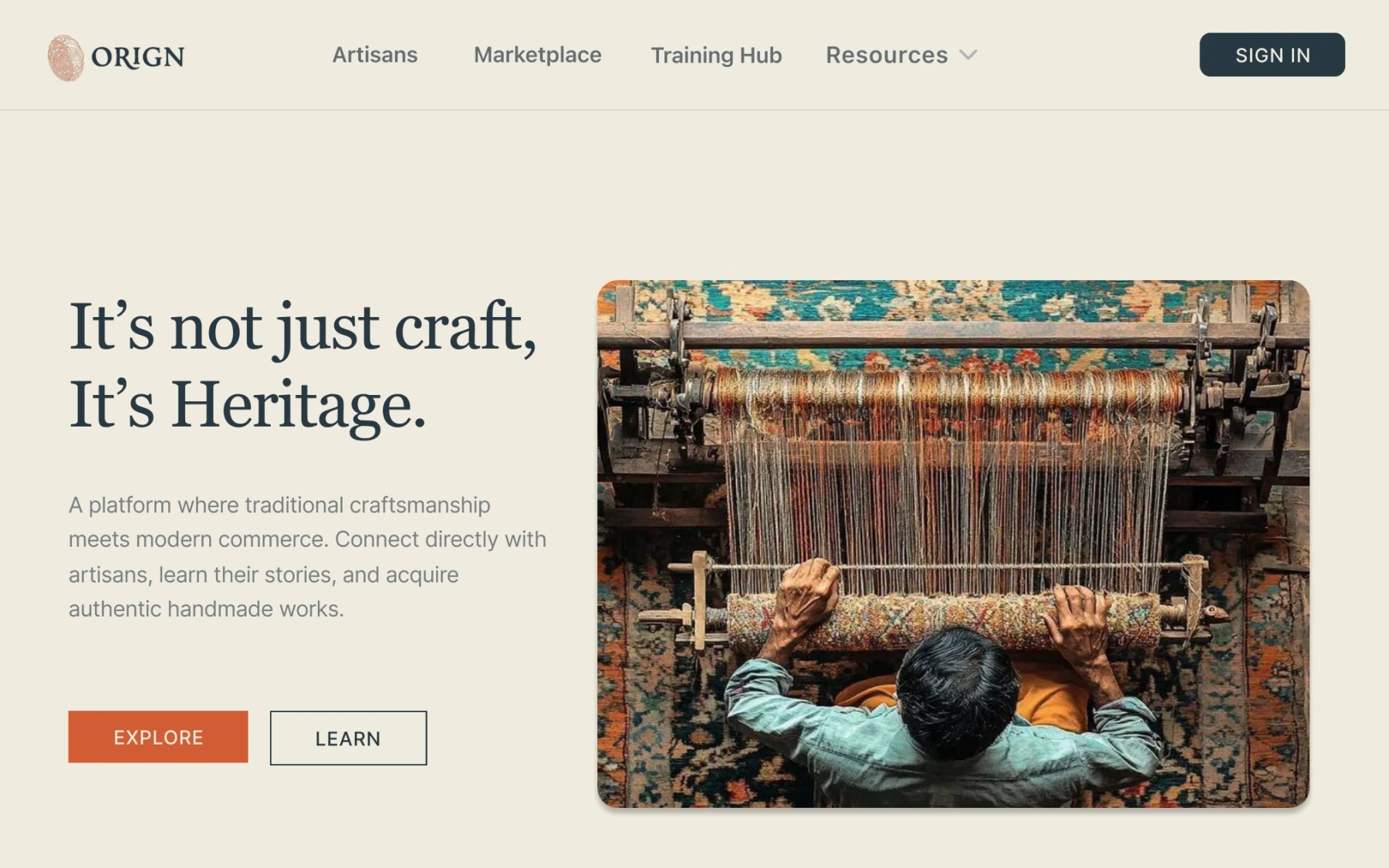
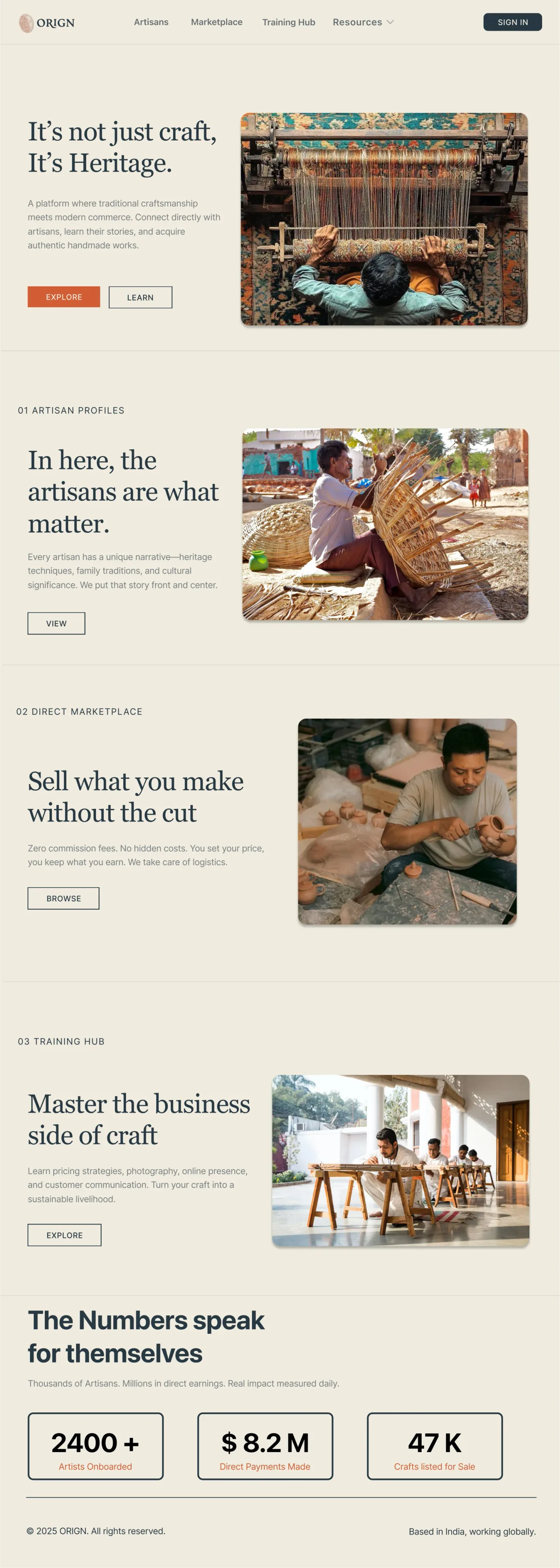
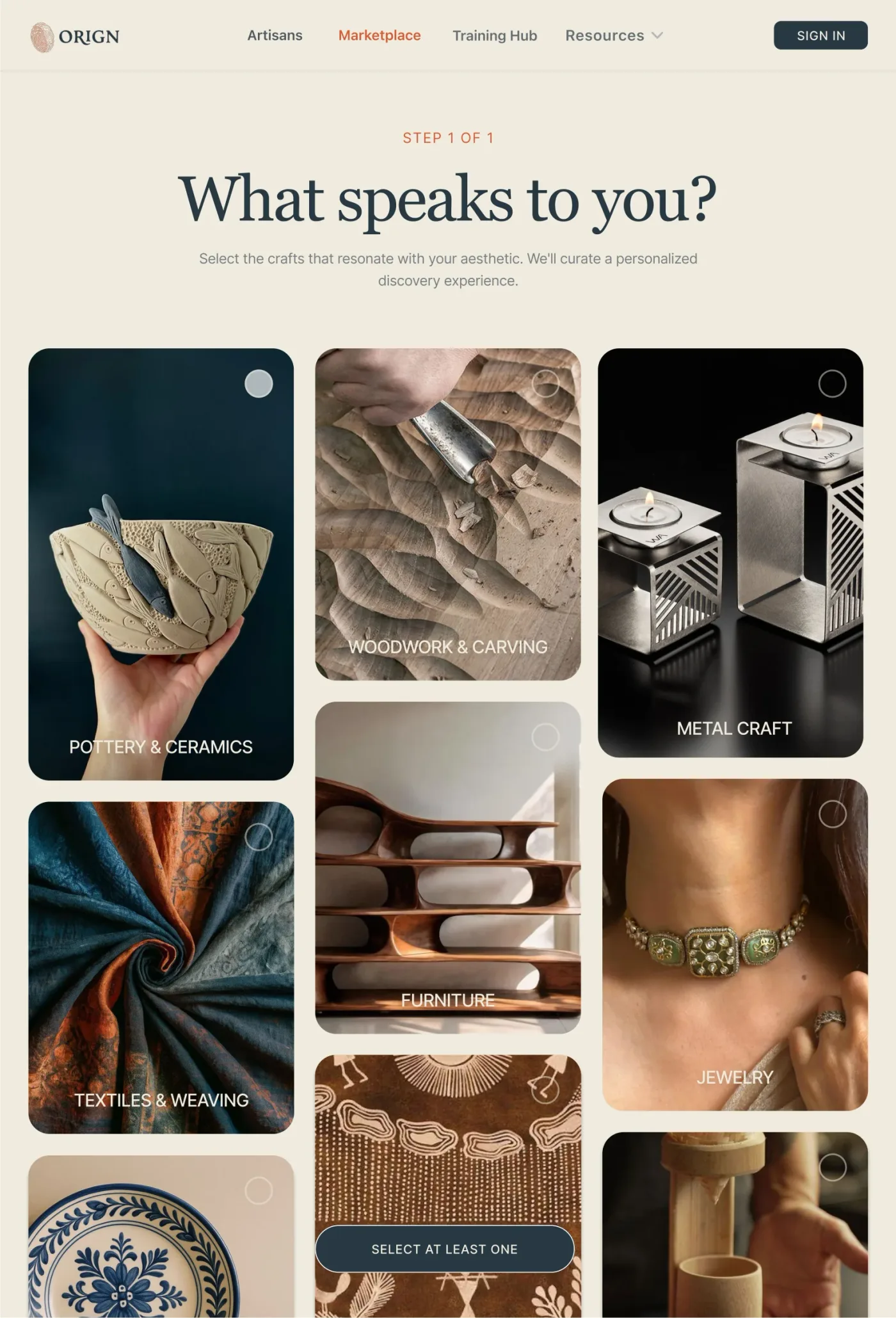
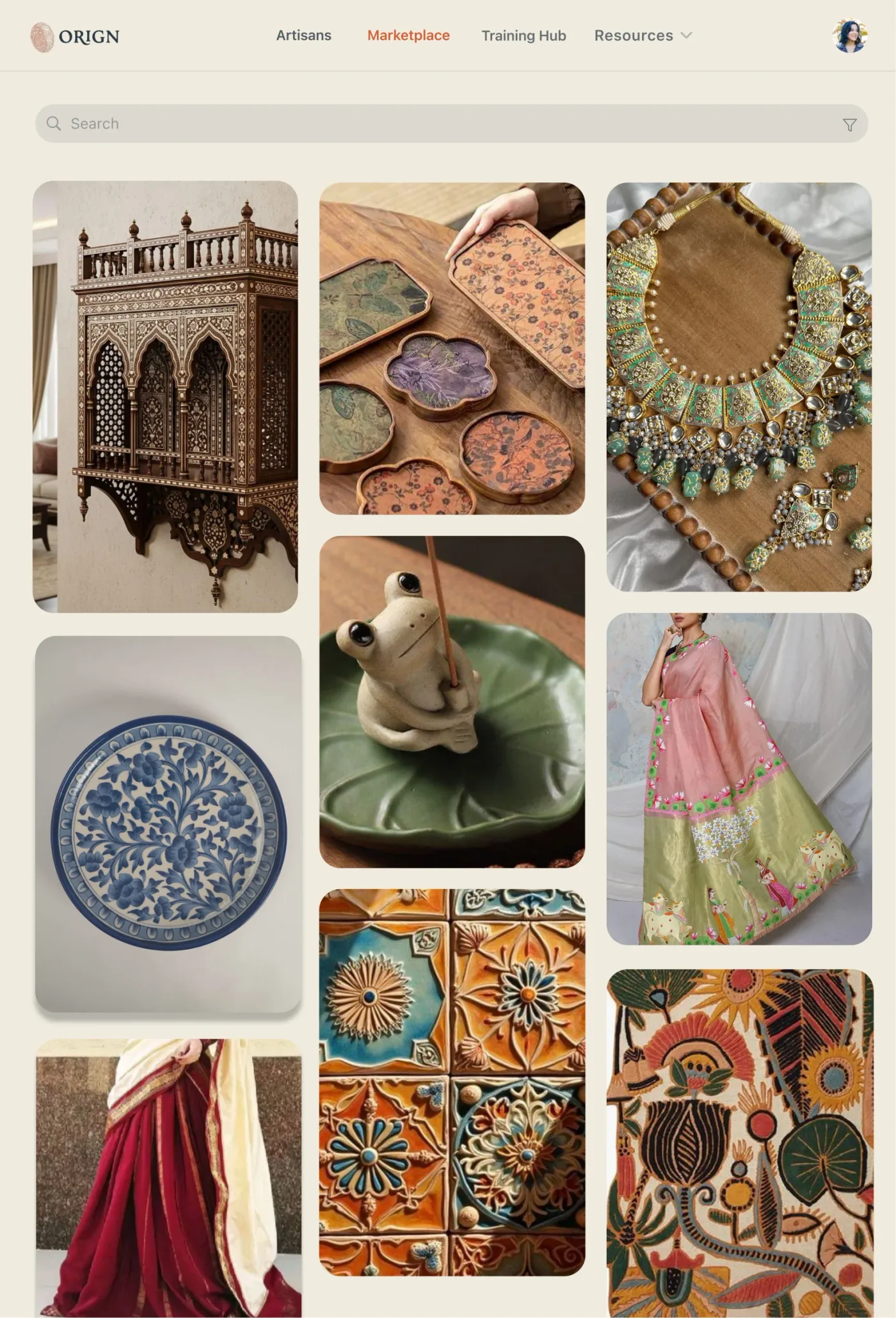
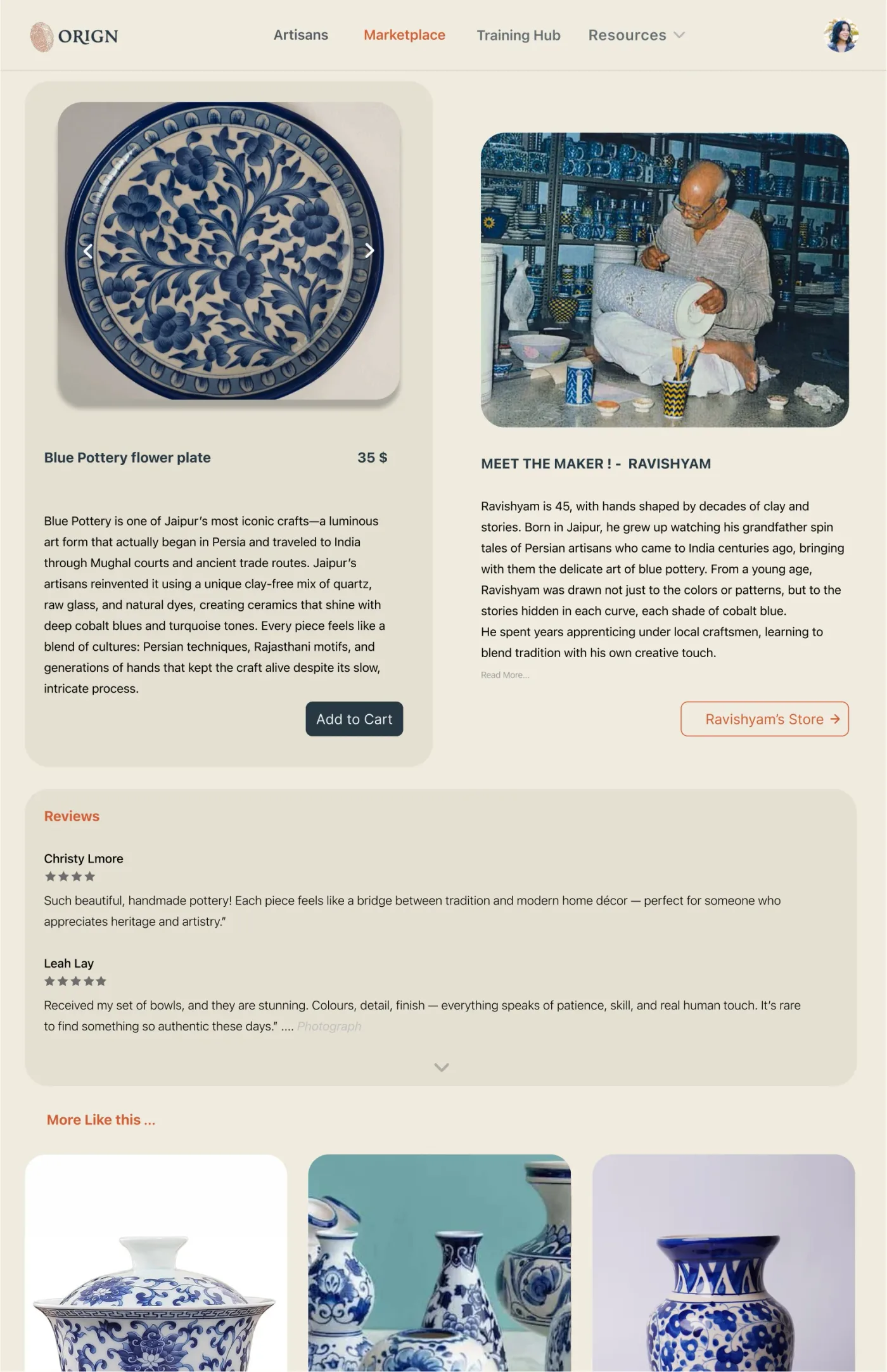
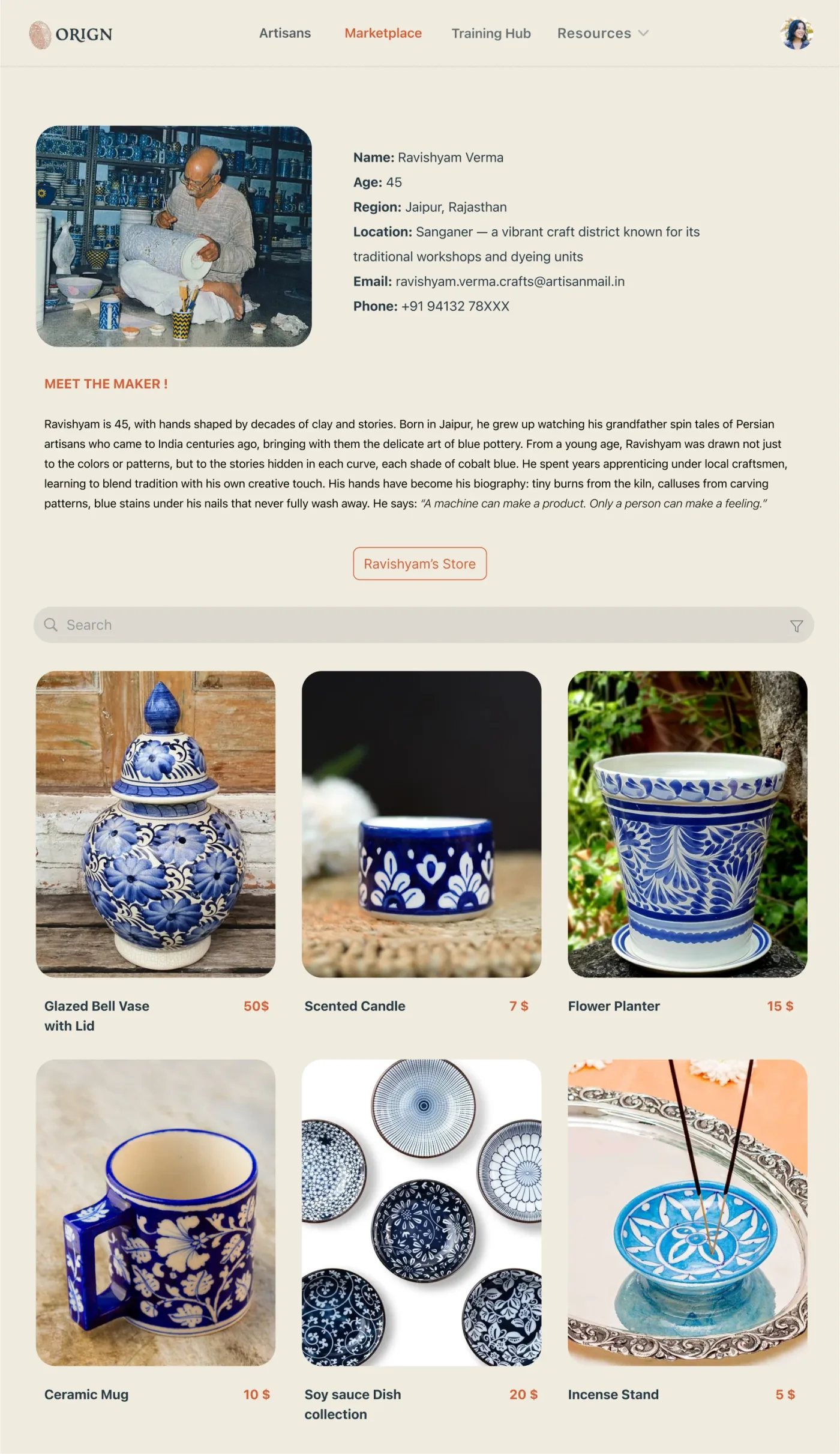
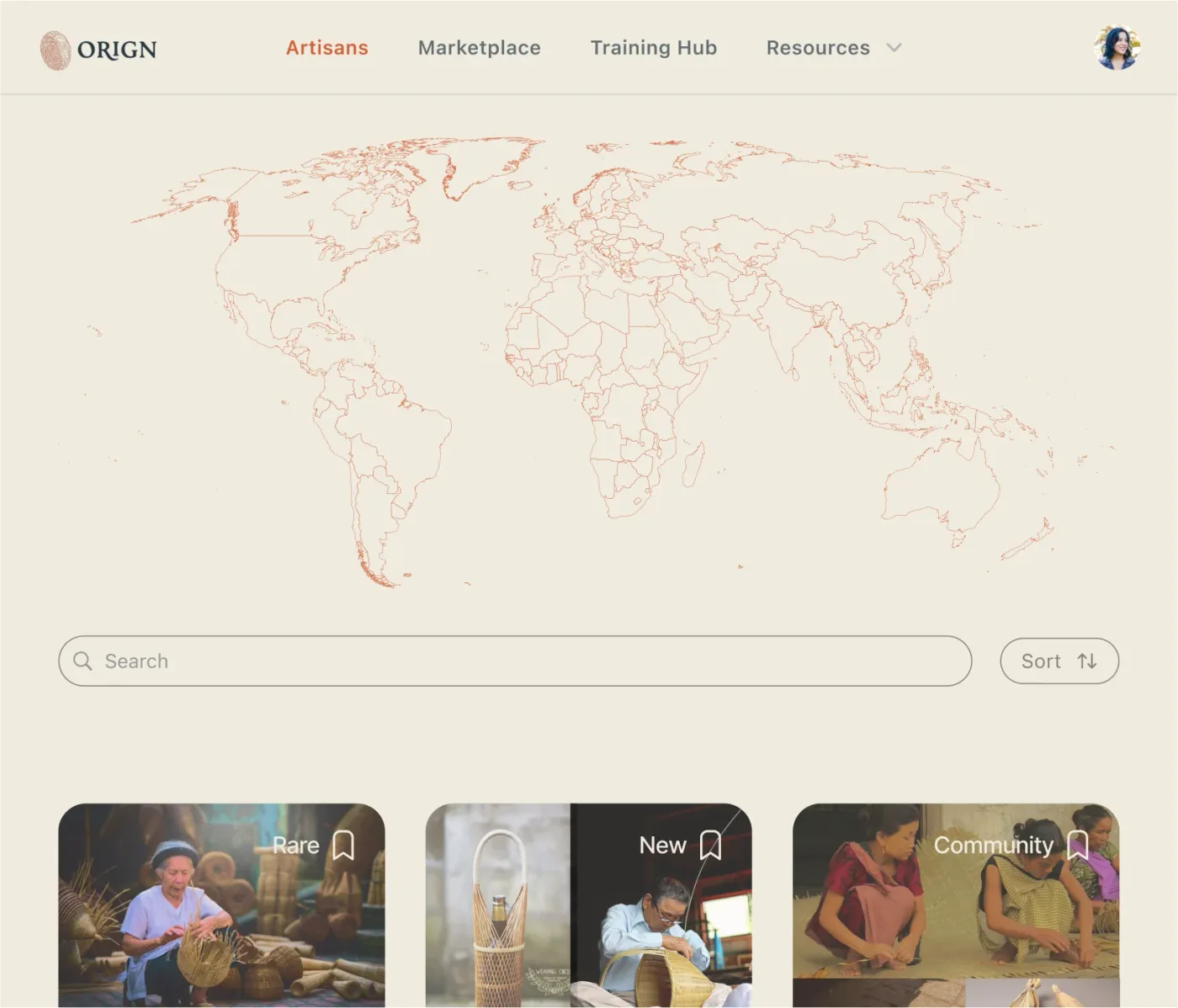
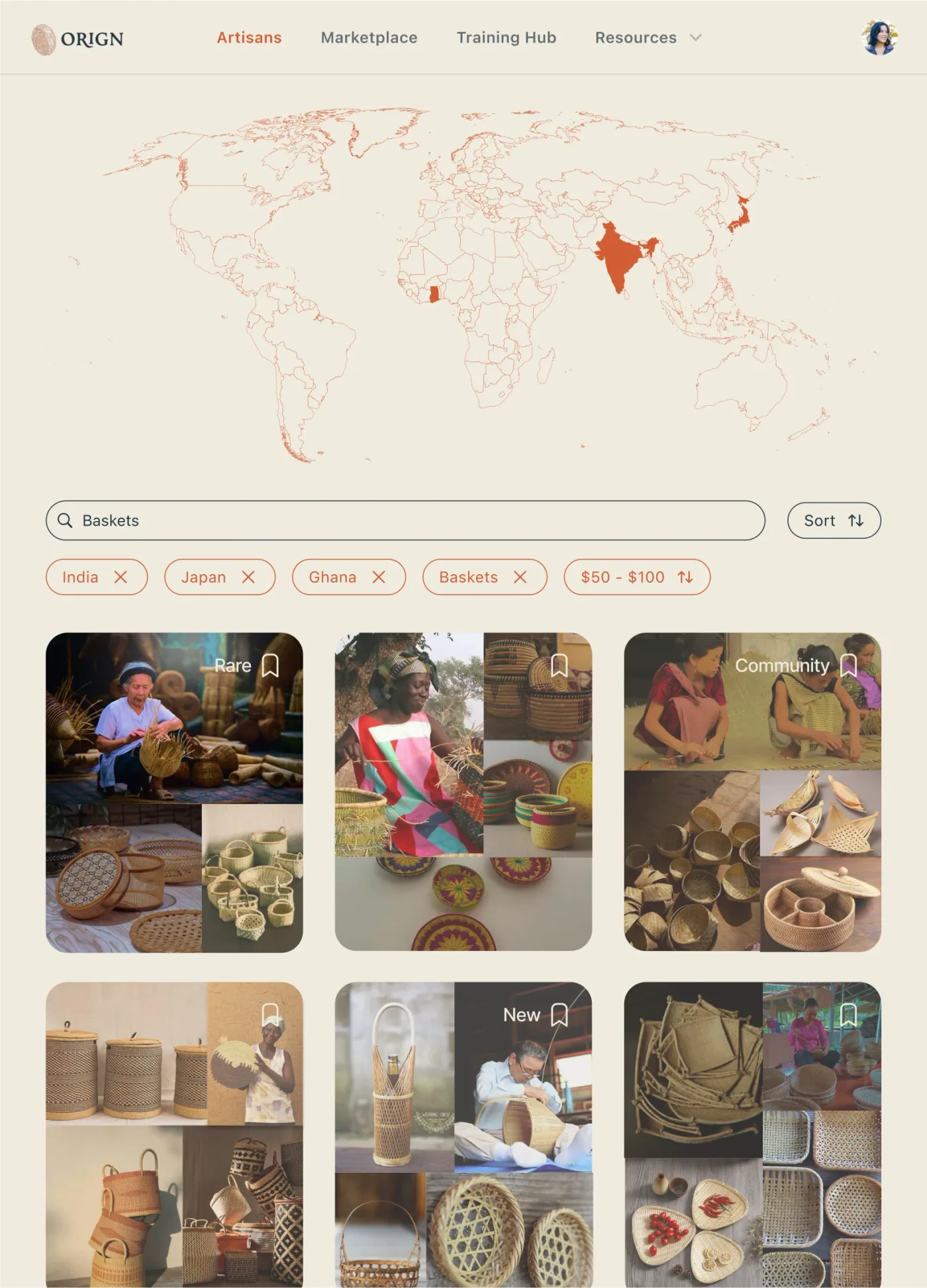
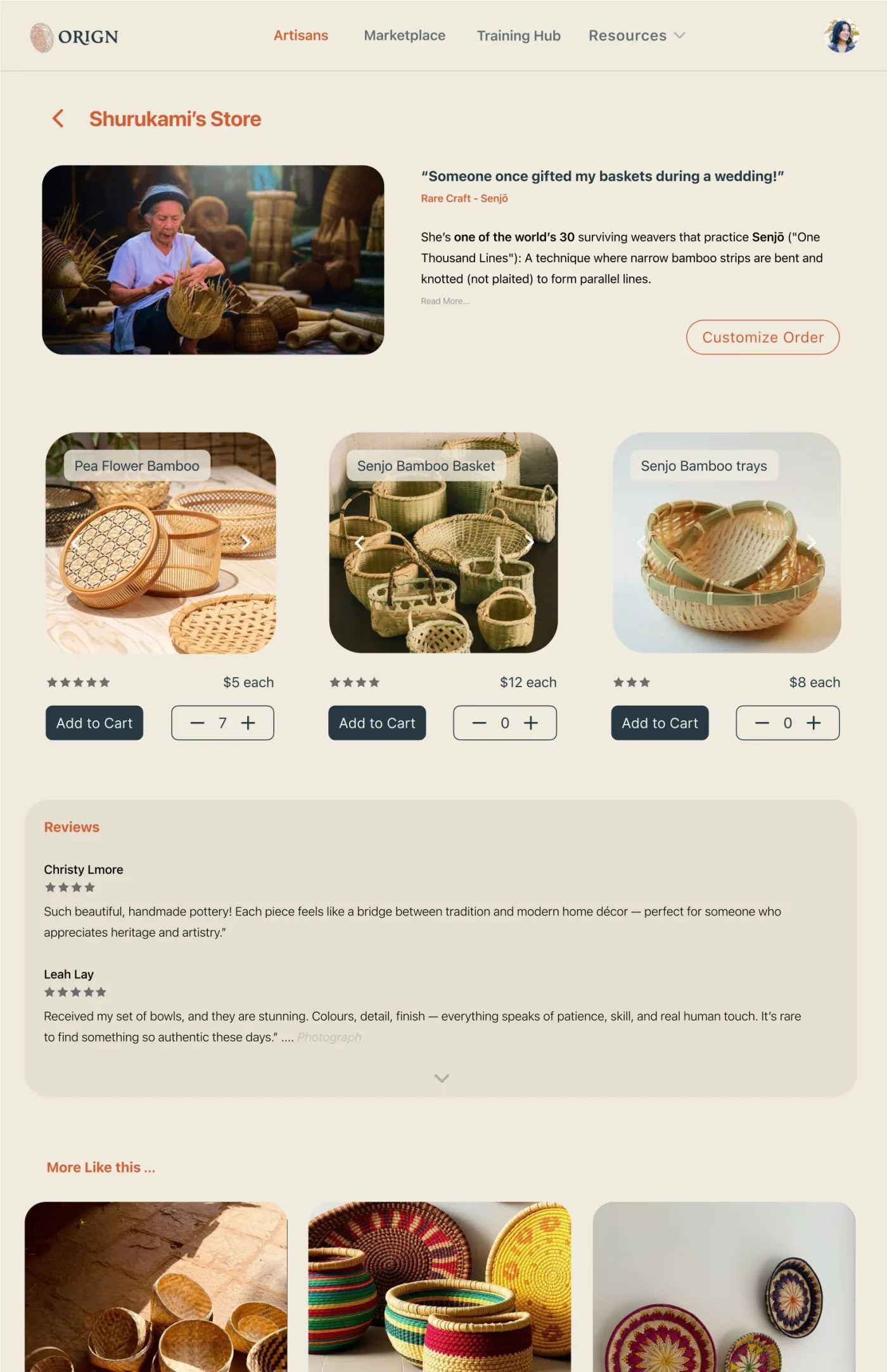
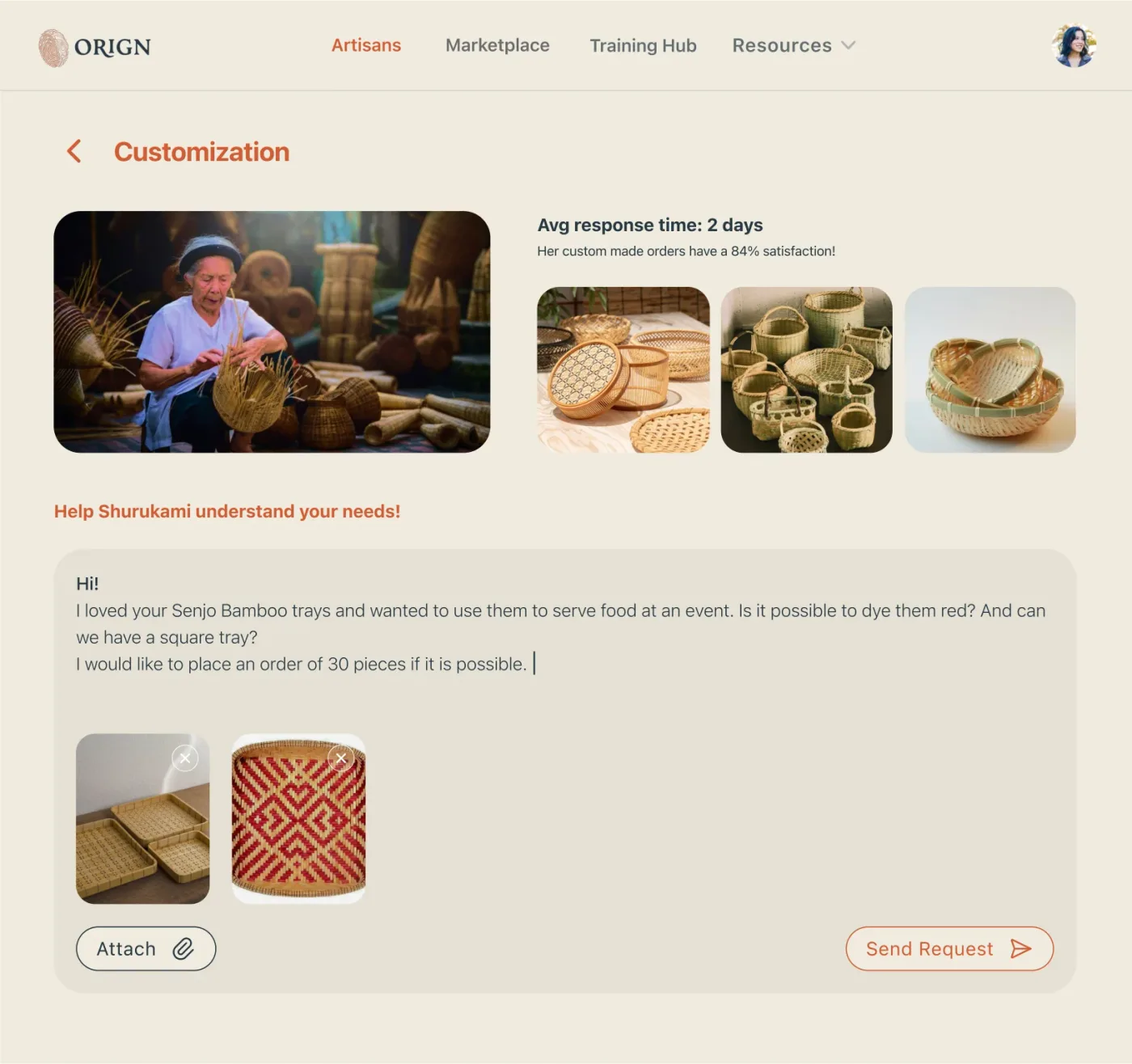
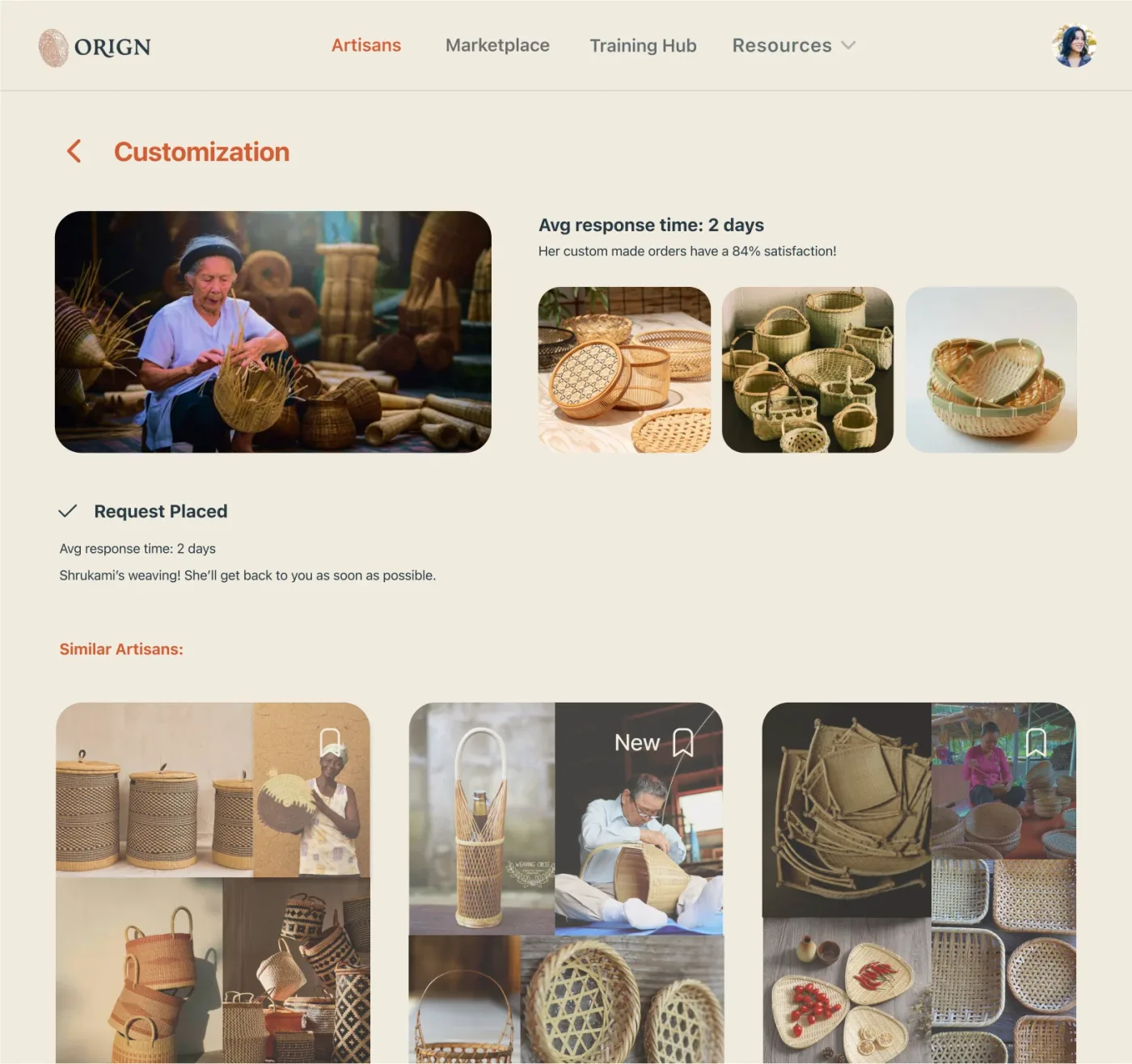
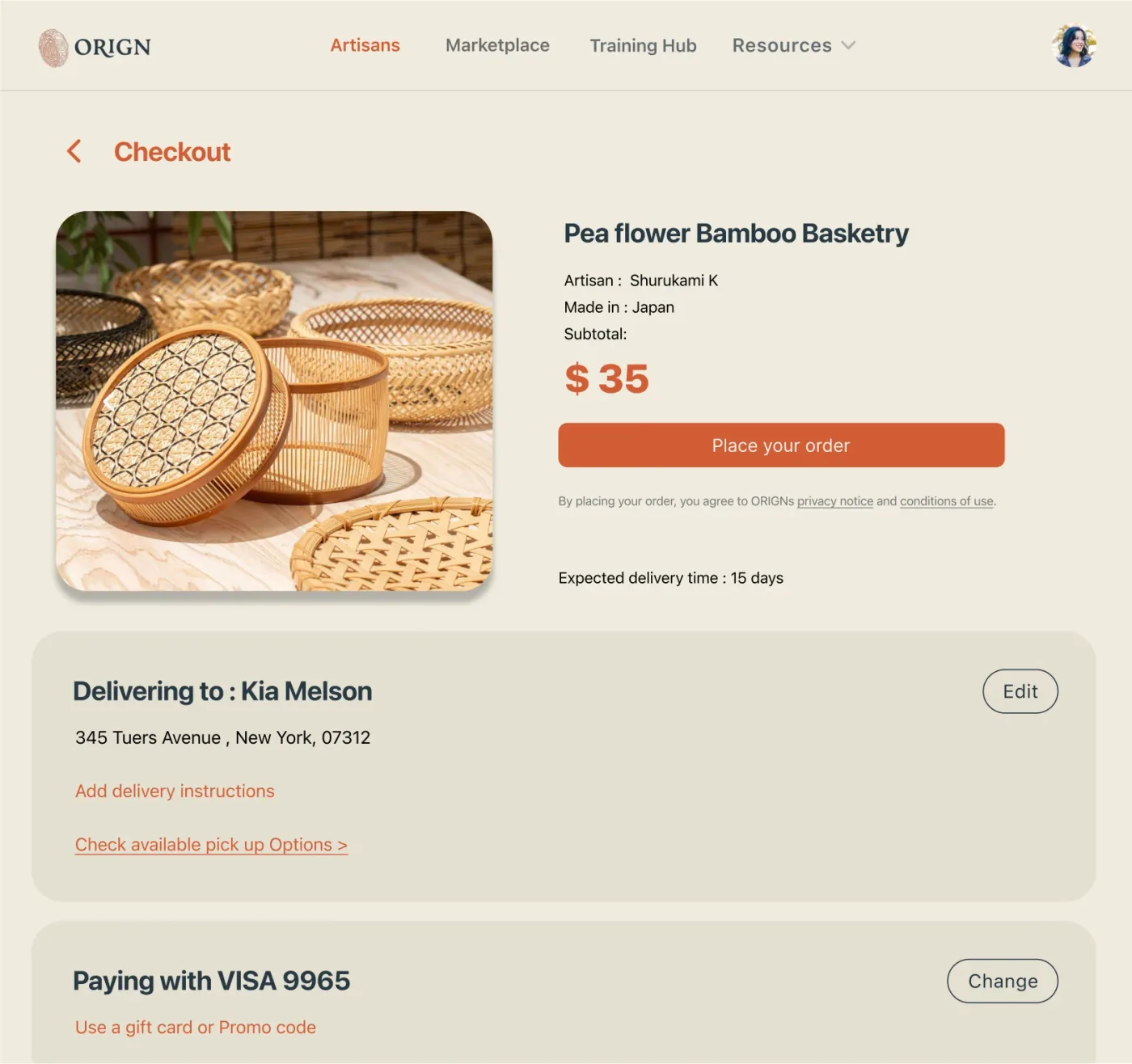
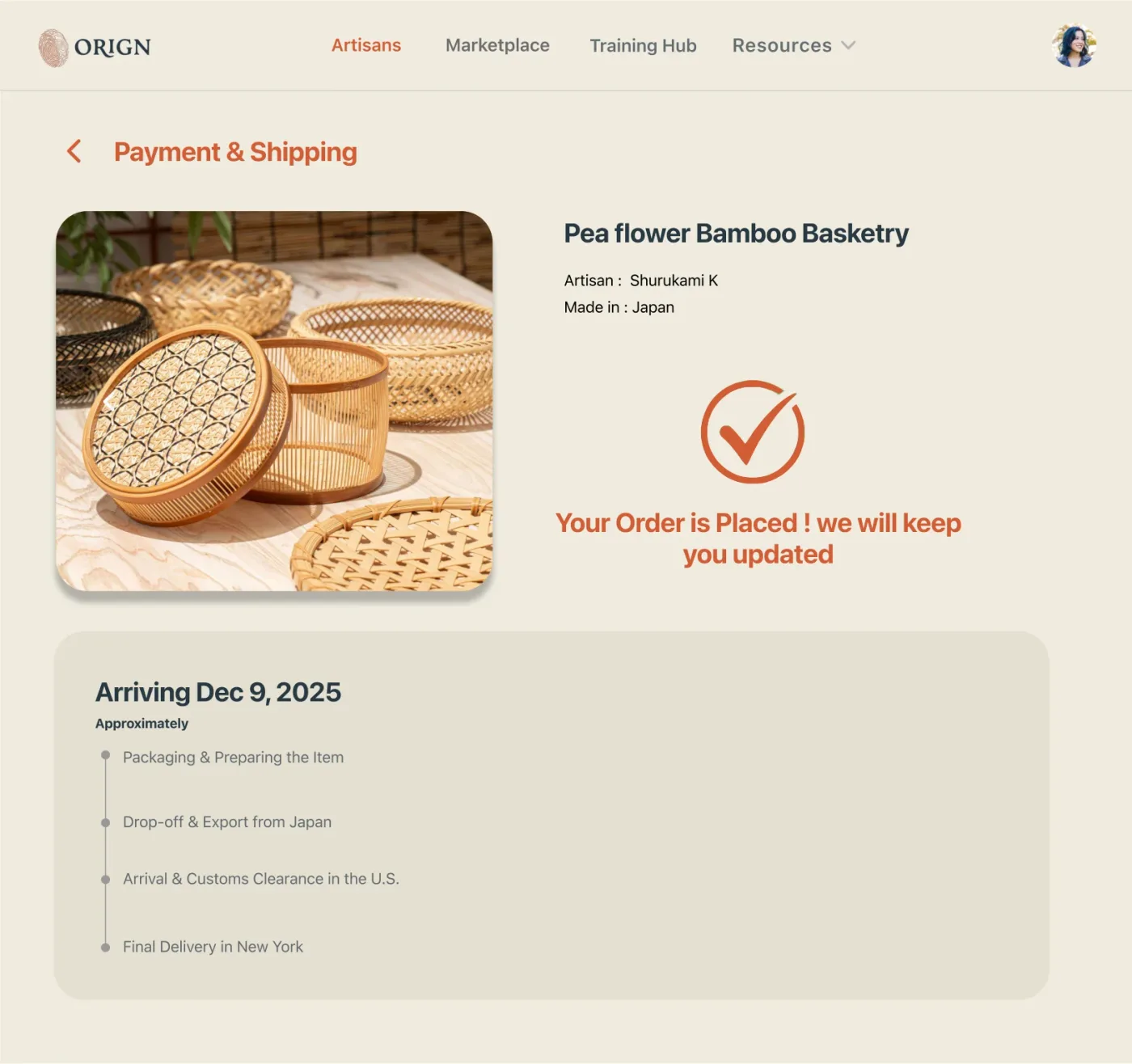
A walkthrough of the working prototype: from the landing page and impact counters, through artisan discovery and maker profiles, to a custom request and checkout.
Every screen
Flow 1 — Marketplace
Flow 2 — Artisans
Measuring Impact
Success is defined by outcomes for the communities, not just platform volume. Impact would be tracked across four dimensions.
Economic
Artisan revenue uplift · repeat customer rate · bulk order volume.
Cultural
Licensed motifs · protected designs · collaborations documented.
Operational
Lead-time difference after training · quality audit pass rate · on-time delivery.
Social
Youth participation in craft · jobs retained in craft clusters.
ORIGN
It's not just craft, it's heritage.
Related Project
Group project
Cluster Revival, Chanderi
Craft Research and Documentation
Restructured operational processes across the Chanderi handloom cluster
Self-Project
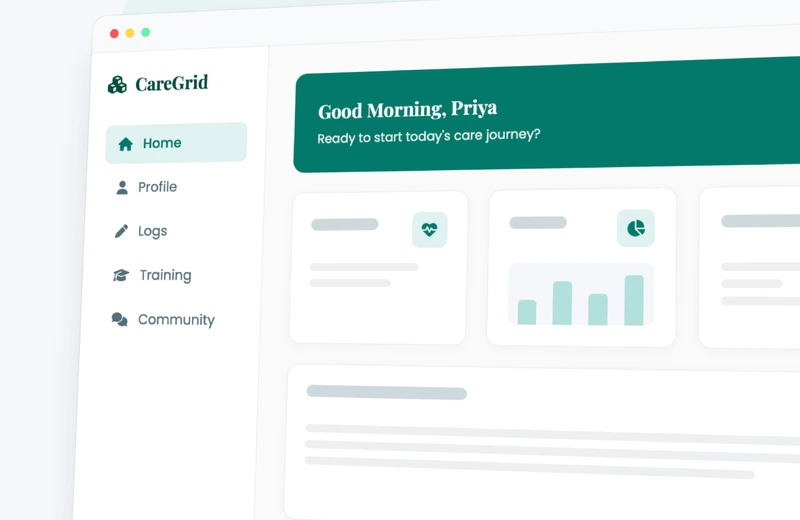
CareGrid
System Intervention
Accepted into the Base44 Accelerator — Top 44 worldwide
Self-Project
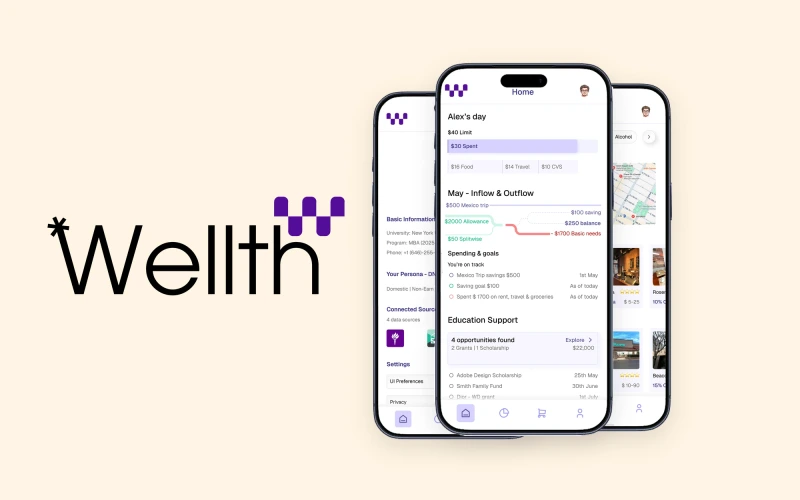
Wellth
AI-Enabled Financial Wellbeing for Young Adults
Mapped the reinforcing loop between financial stress, reactive decisions and lower stability through 17 interviews, 2 focus groups and 3 expert conversations