
03 Social Venture & Fintech Strategy
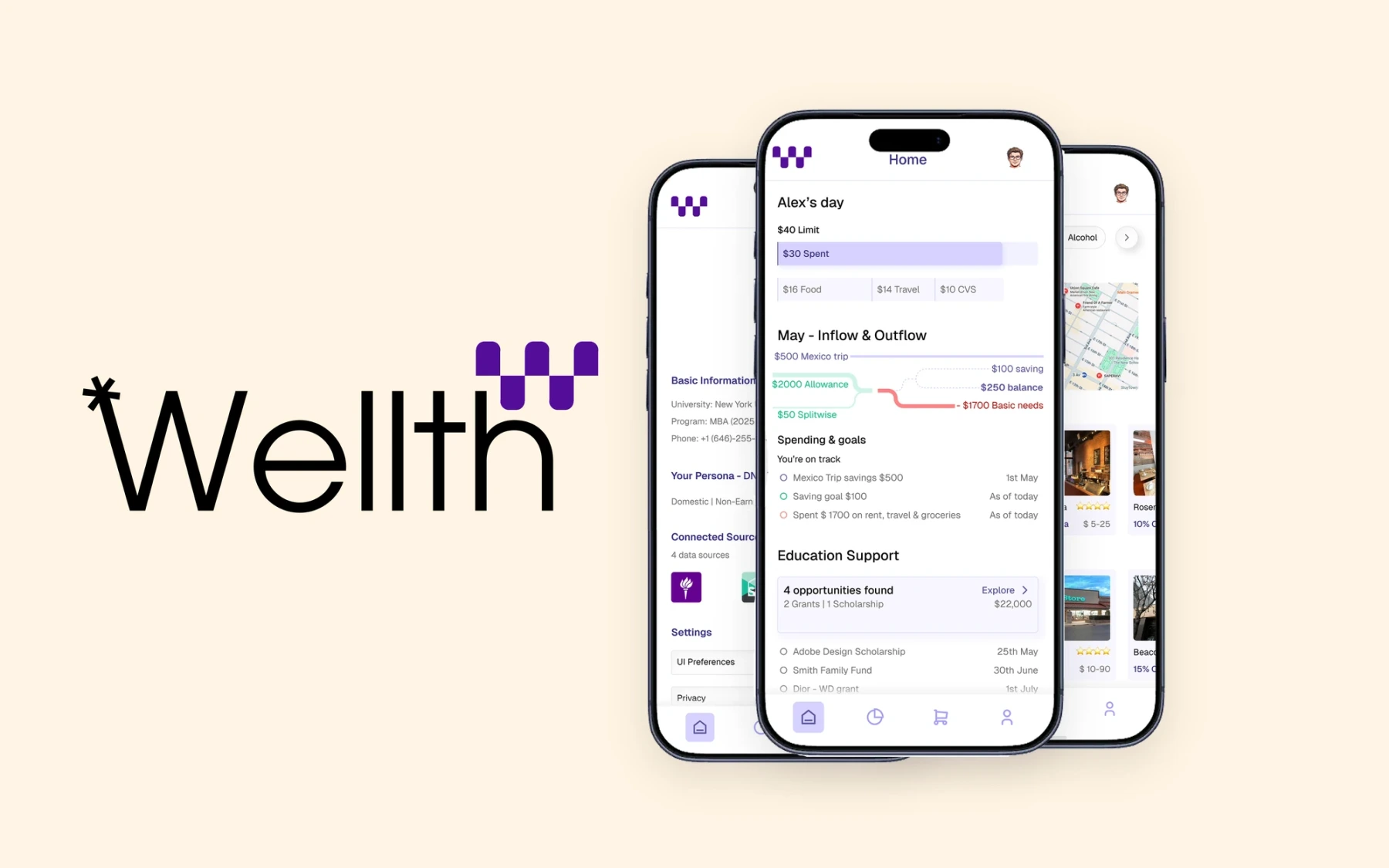
Wellth
AI-Enabled Financial Wellbeing for Young Adults
Strategic Context
Young adults have never had more financial tools, and many have rarely felt less sure what to do with them. Budgeting apps show where the money went. They don’t help with the rent due Friday or the tuition installment landing next week.
That gap is sharpest for graduate students in New York City: high debt before a stable career, irregular income, rising living costs and, for international students, work restrictions and no U.S. credit history. Wellth is the venture strategy built around that gap: an AI-enabled financial wellbeing system that predicts constraint moments before they happen, guides decisions in real time, and connects students to the university and vendor support that already exists but sits underused.
Money Beyond Numbers
Empowering action over tracking guilt.
The Problem
Data-rich, insight-poor
Persona · Alex, NYC graduate student, $40K+ debt
I'm terrified to check my account balance!
Alex has every tool, and still doesn’t know what to do next. Current budgeting apps offer retrospective visibility: they track expenses after the money is spent. The result is reactive decision-making, short-term trade-offs, and avoiding financial planning.
Orientation
Tracks expenses after the money is spent
Predicts constraint moments, like rent and tuition deadlines, before they happen
Decisions
Reactive, short-term trade-offs
Proactive, planned decisions supported in real time
Tone
Tracking guilt
Empowering action over tracking guilt
Support
Fragmented across university offices and separate apps
One bridge to vendors and underused institutional aid
The scale of the squeeze
$0K+
average graduate student debt
0%
abandon budgeting apps
0%
experience financial anxiety
0%
sacrifice essentials for bills
Figures as presented in the Wellth pitch.
A dense, reachable market
>0,000
university students are in New York City at any given time
The illusion of support
On paper, students are surrounded by help. In practice, none of it connects to the moment they need it.
Budget apps
Rocket Money, Credit Karma, Coinbase and Tiller track past spending, but have zero connection to a student's upcoming university deadlines.
University billing
Geared toward long-term annual tuition, and completely disconnected from a student's real-time, day-to-day cash constraints.
Emergency funds
Hidden away in the Dean's office and burdened by high-friction paperwork that is too overwhelming to navigate during a crisis.
The outcome is decision paralysis, cognitive load and a fragmented system spanning The New School, NYU, CUNY, Columbia and the local economy.
From mind to macro
The problem is shaped by several systems working together, not by individual behavior alone.
Policy
Immigration rules restrict work options for international students, limiting how they can respond to financial pressure.
Institutional
The higher education system sets tuition and access to funding, and the financial aid system limits who can receive support, across offices that rarely connect.
Technological
Financial tools are designed for stable incomes and financially literate users, so they show the past rather than guide the future.
Behavioral
Students track expenses after spending, make short-term trade-offs and often avoid planning altogether.
Psychological
Stress clusters around specific triggers — rent, tuition deadlines, unexpected costs — and confidence in long-term decisions is low.
Research & Insights
The landscape: where existing solutions cluster
Mapped with the Ashoka Discovery Framework, existing organizations concentrate in financial education, emergency aid and financing. Few address behavior and decision-making, and international students are rarely addressed directly.
| Problem theme | Financial education | Emergency / short-term | Financing & cost reduction | Institution-based support | Behavior & decision-making |
|---|---|---|---|---|---|
| Financial literacy gaps | GradReady | — | — | University financial wellness programs | — |
| Emergency financial instability | — | Edquity | — | University emergency funds | — |
| High cost / unfair financing | — | — | Juno, Pave | — | — |
| Fragmented support systems | — | — | — | University programs (NYU, Rutgers, etc.) | — |
| Weak financial decision-making | GradReady | — | — | — | Gap |
| International student exclusion | — | — | — | Limited support (universities) | Gap |
| Themes with a solution | 2/ 6 | 1/ 6 | 1/ 6 | 4/ 6 | 0/ 62 flagged gaps |
Most solutions are siloed and focus on one dimension of the problem.
Four models worth learning from
Beam (formerly Edquity)
Streamlines emergency funds through a centralized, mobile-friendly app: students apply in under seven minutes and receive decisions within 24 hours.
MyBnk
Brings financial education into schools through real micro-banks run by young people, moving from theory to actual behavior change.
MPOWER Financing
Approves loans for international students on future earning potential instead of past credit, bundled with visa support, literacy courses and career prep.
Esusu
Reports on-time rent payments to the credit bureaus through property-management integrations, so renters build credit passively.
Barriers and the design principles that answer them
Friction
Cognitive overload: tools and aid applications demand heavy manual input and high financial literacy
Seamless integration: meet users where they are, inside systems they already use (Esusu, Beam)
Underwriting
Retrospective, exclusionary underwriting that penalizes a lack of credit history
Forward-looking alternative data: rent and future earning potential (MPOWER, Esusu)
Fragmentation
Education, emergency aid and credit-building treated as separate industries
Bundled behavioral support: pair access with psychological and behavioral support (MyBnk, MPOWER)
Insight from the scan
More data and more financial literacy content aren't enough to change behavior. The most successful models automate the hard parts and reduce cognitive load.
Talking to students and experts
Primary research focused on real behavior rather than opinions: participants walked through the last time they faced financial stress or made an important financial decision.
0
semi-structured interviews
0
focus group discussions
0
expert conversations
Transcripts and field notes were cleaned and coded into seven themes. These are early-stage findings.
Financial management practices
Informal and inconsistent: expenses are tracked after spending, budgets shift with immediate needs, and formal tools are rarely used.
Financial stress triggers
Stress isn't constant. It clusters around rent payments, tuition deadlines and unexpected expenses.
Decision-making under constraint
Short-term, constraint-driven trade-offs between essential and non-essential spending, with long-term planning dropping away under pressure.
International student constraints
Work restrictions and limited access to funding mean a lower margin for error and heavier reliance on savings or family support.
Awareness of support systems
Awareness of emergency funds and aid is low, and even when students know about them, processes are unclear and guidance is missing.
Financial confidence and mindset
Confidence in long-term decisions is low. Some students avoid financial planning altogether because of stress or uncertainty.
Time constraints in master's programs
A short program pressures students to manage finances, coursework and job search at once, favoring immediate outcomes.
Experts described the challenges as recurring and multi-layered. Support exists, but it is underutilized and fragmented across institutional units, with a gap between available resources and student engagement in the early stages of financial stress.
Four students, four kinds of pressure
Yuna
The constrained international student
- 23 · South Korea · Master's, NYU
- F-1 work limits · no credit history · manual tracking
- Wellth: forward-looking, alternative predictive insight instead of retrospective credit history
Alex
The overwhelmed domestic student
- 24 · USA · Master's, The New School
- Reactive checking · high debt · cognitive load
- Wellth: predicts constraint moments and nudges before they hit
“I'm terrified to check my account balance!”
Priya
The first-gen university student
- 25 · USA · Master's, Columbia
- Campus grants · frustrated · seeking aid
Jordan
The income-volatile gig worker
- 26 · USA · Master's, CUNY
- Irregular payouts · forced trade-offs · stressed and anxious
- Wellth: routes to emergency funds without the friction of manual searching
Mapping the system
Financial wellbeing isn’t driven by a single factor. It emerges from the interaction of economic conditions, structural constraints and student behavior, with financial stress as the central node.
Hover or focus a node to trace its links. On a phone, scroll the map sideways.
The reinforcing loop: financial stress pushes students toward reactive decisions, reactive decisions erode financial stability, and lower stability raises stress again. Without intervention, students stay in a cycle that worsens outcomes over time.
Four leverage points emerge from the map.
Decision-making support
Students act reactively under stress, which points to a gap in tools that support better decisions in real time.
Income flexibility and constraints
Structural limits, especially for international students, reduce the ability to respond to financial pressure.
Access to support systems
Resources exist but are fragmented and underutilized, which calls for better integration and accessibility.
Confidence and mindset
Low confidence reinforces negative cycles, so the intervention has to go beyond information and tools.
The most promising leverage point sits where technology and psychology meet. A predictive, AI-enabled system that guides future decisions and lowers cognitive load during high-pressure moments, like rent deadlines, can break the loop between stress and reactive decision-making while building confidence.
Finding the root cause
Why do young adults feel financially anxious?
They struggle to manage and predict their financial future.
Why can't they predict their financial future?
They lack tools that provide forward-looking insight, since most tools focus on past spending.
Why do existing tools focus on the past?
Financial systems are designed for stable income patterns and financially literate users.
Why isn't financial education more accessible?
It isn't embedded in real-life decision-making contexts.
Why is financial education disconnected from behavior?
Financial services prioritize transactions and profit over user wellbeing.
- Root cause identified
The financial ecosystem lacks adaptive, accessible and predictive systems that support real-life decision-making and behavioral needs.
Strategy
How Might We
How might we help young adults make informed financial decisions, build resilience, and improve long-term economic outcomes?
Three target areas frame the work: pre-career student debt, income volatility and the rising cost of living.
Theory of change
01 · The baseline
The problem space
- Young adults are data-rich but insight-poor: tools show past spending but offer no predictive clarity
- Support is fragmented across institutional units
- International students face compounded limits: work restrictions and a lower margin for error
02 · The inputs
Wellth's interventions
- Predictive AI guidance that looks forward, not back
- Integrated support navigation: a bridge to underused aid and emergency funds
- Human-centered design built on empowerment over shame
03 · The mechanism
How behavior changes
- Less cognitive load in constraint moments
- A shift in financial mindset, from avoidance to engagement
- From reactive to planned action
04 · The outcomes
The impact
- Short term: lower financial anxiety and more use of existing university support
- Long term: stronger resilience and better economic outcomes
- Ultimate impact: sustainable financial wellbeing over short-term optimization
Three assumptions have to hold for it to work.
User trust and data privacy
Young adults must be willing to share financial data with an AI tool, which demands a system that is explainable, ethical and trustworthy.
A behavioral shift is possible
Predictive insight and behavioral guidance can break the loop of financial stress and reactive decision-making.
Institutional cooperation
Fragmented university support systems can be integrated, or navigated, through an external platform.
What Wellth is
Predictive, forward-looking insight
Wellth's AI engine shifts users away from retrospective tools. It predicts constraint moments, like rent or tuition deadlines, before they happen.
Real-time behavioral guidance
Delivers proactive decision-making support and nudges during high-pressure moments to reduce cognitive load and panic.
An integrated support bridge
Acts as the central hub, connecting students directly to consumer vendors and underutilized institutional resources, like emergency grants.
Students gain clarity in financial decisions, access to low-cost deals targeted at them, and the means to use the aid they’re entitled to.
Vision
A world where young adults, especially students, navigating financial complexity are empowered to make confident and informed financial decisions that lead to long-term financial stability and wellbeing.
Mission
To improve financial decision-making for young adults by providing AI-powered, forward-looking guidance and connecting users to relevant financial support systems in real time.
Principles
Human-centered first
Emotional and psychological realities come before financial data.
Empowerment over shame
Build confidence through positive reinforcement rather than guilt-driven behavior change.
Data transparency and privacy
Systems must be explainable, ethical and trustworthy.
Equity and access
Solutions must work for diverse users, including low-income and underserved populations.
Long-term impact
Sustainable financial wellbeing matters more than short-term optimization.
Wellth’s brand archetype is a guide. It doesn’t tell users what to do or act as an authority on their finances. It supports them in the moments they feel unsure or overwhelmed, with clear, timely and relevant guidance.
The Product
Core screens
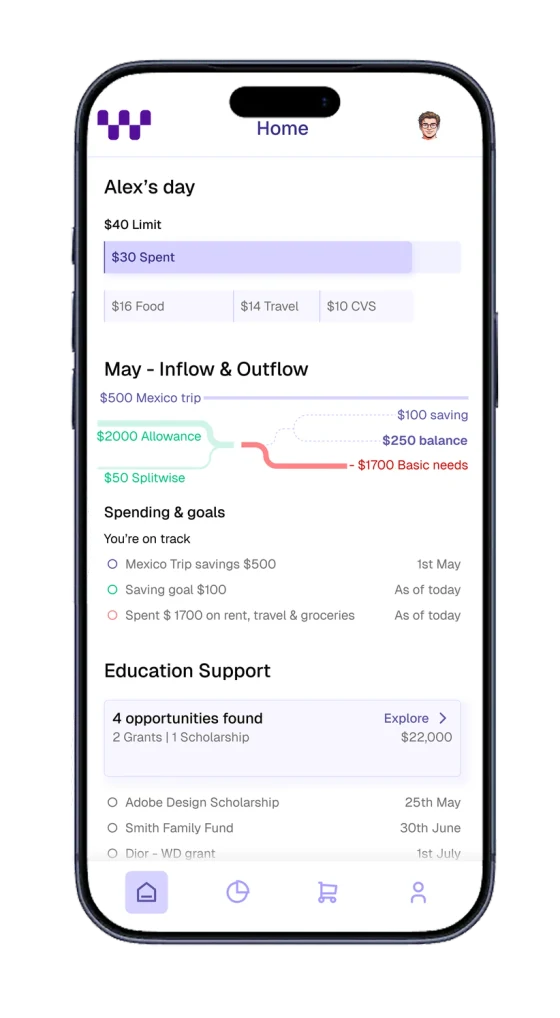
Home
- Contextual spending alongside goals
- Future-facing balances, not just math
- Saving is subjective — Wellth knows your definition
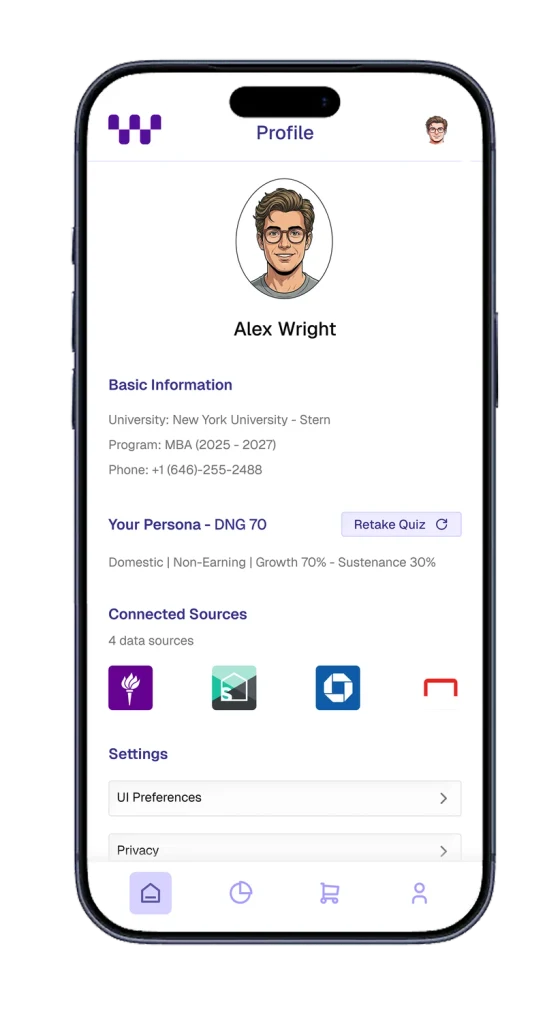
Profile
- Everything Wellth knows about you is here
- Your finance persona at a glance
- Transparent about data access — not creepy
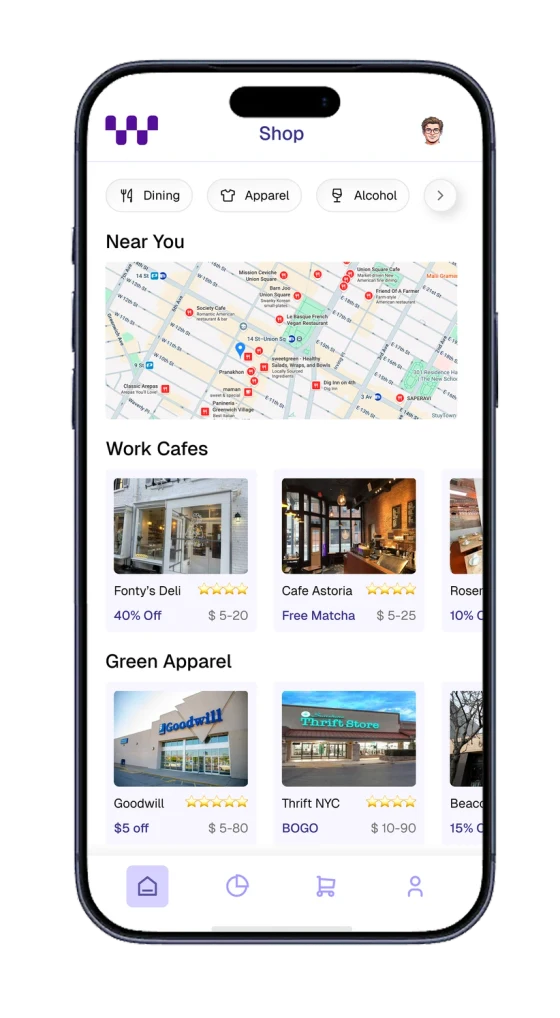
Shop
- No more guesswork for study breaks
- A hyper-personalized map
- Vendors get meaningful, targeted exposure
Click a phone for the full-resolution screen.
Names, balances and merchants shown are illustrative placeholder content.
Going deeper: six behavioral features
Beyond the core screens, the product extends into context, analytics, planning, goals, personality and community. These concept screens carry the same idea through each layer.
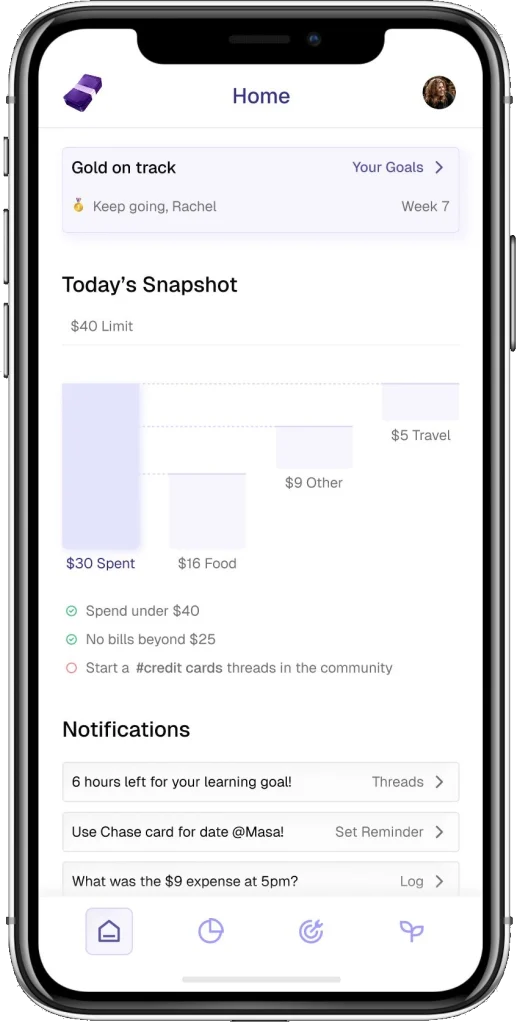
Numbers don't explain money. Context does.
- Build a healthy relationship with money
- Suggestive, proactive tone for nudges — not scolding
- Quick Stories help demystify spends
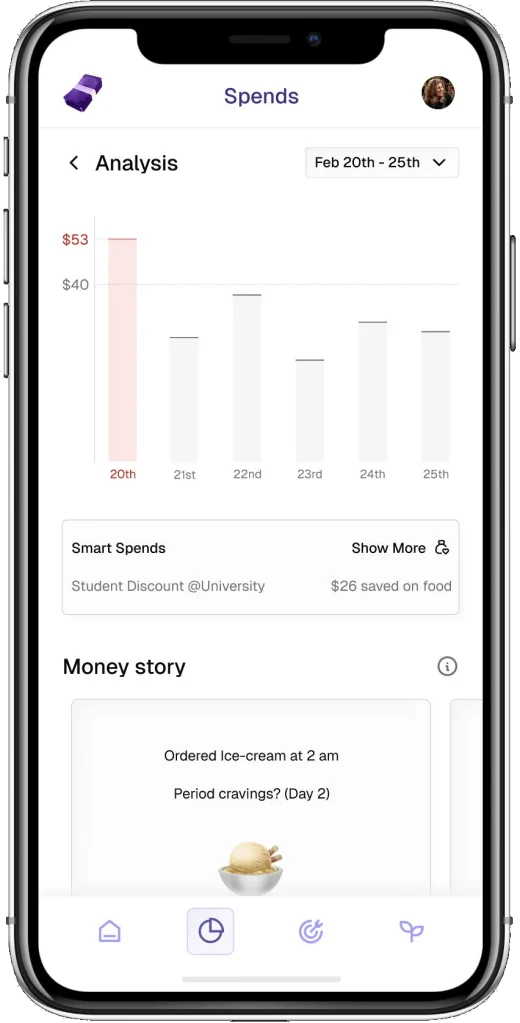
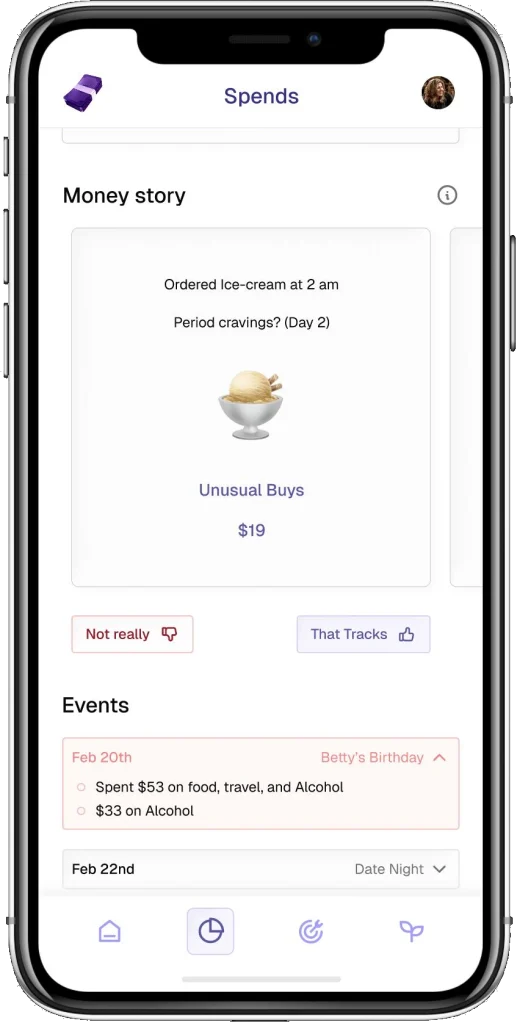
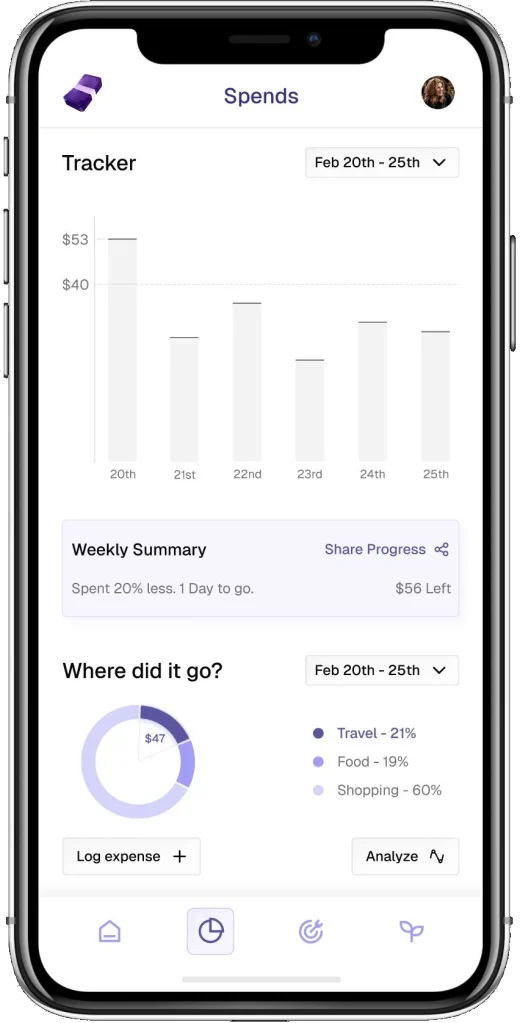
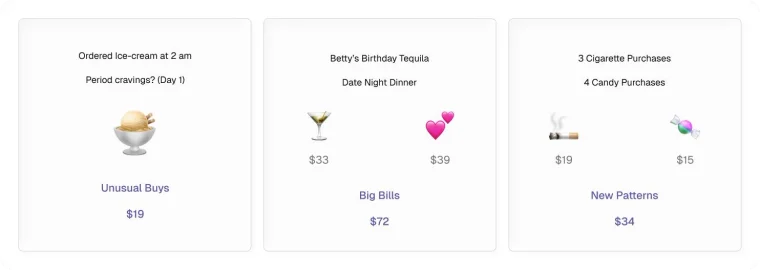
Analytics, but the numbers speak.
- Money is spent, but smartly
- People are complex, and data helps with storytelling
- Context is gathered from a period tracker, Google Calendar and the digital wallet
- The goal: “Oh, now I know why I overspent.”
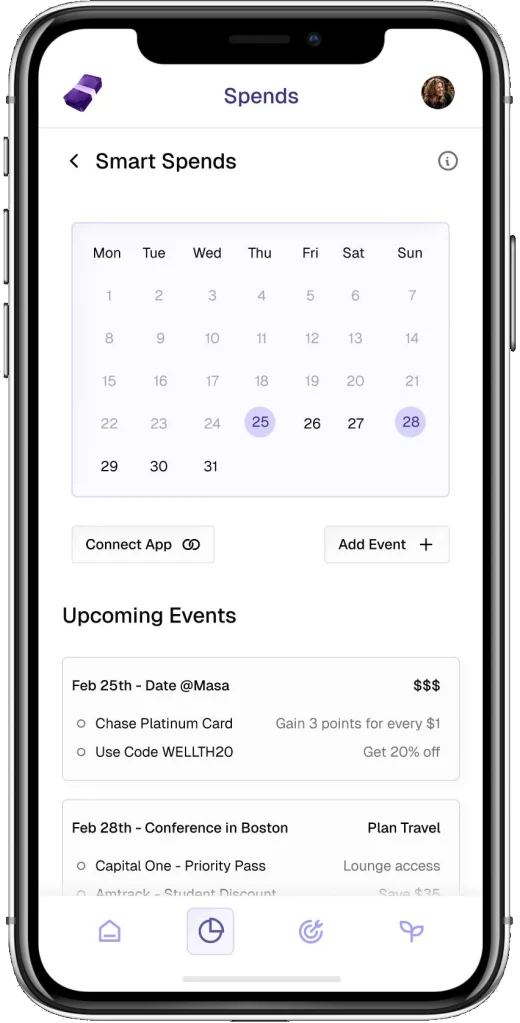
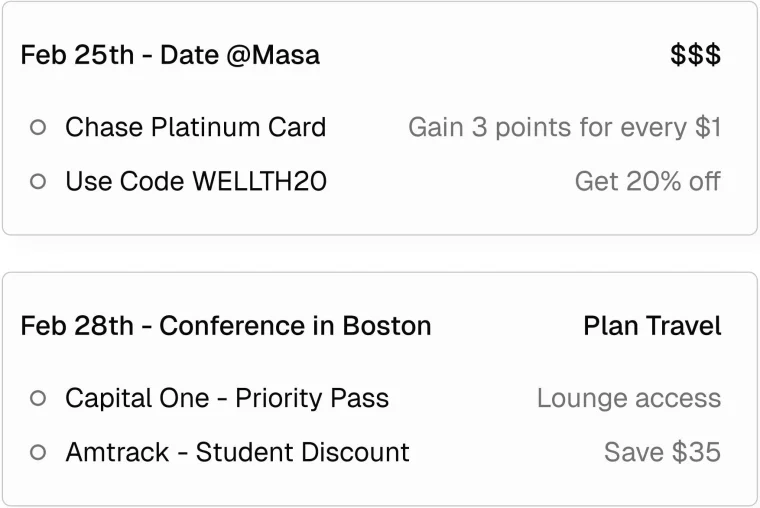
Wealth is more than money. Strategy is everything.
- Planning helps spend less
- We can plan better if we know you well
- Your cheat codes to spend less and get the best deals — matched to the events on your calendar
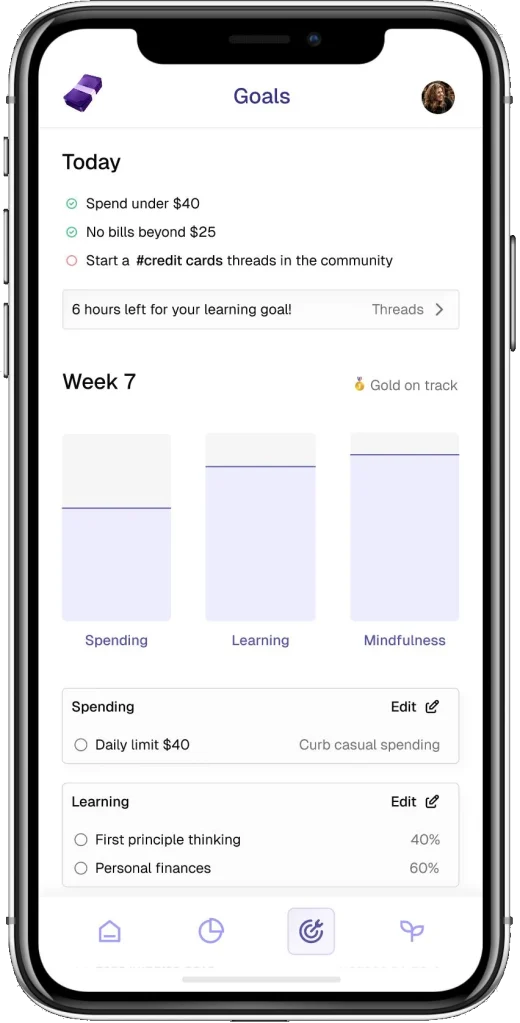
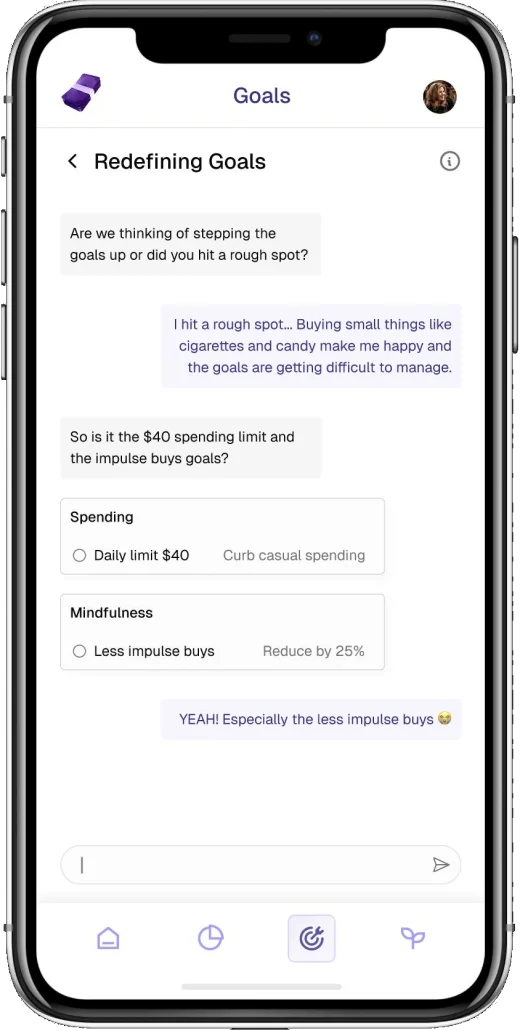
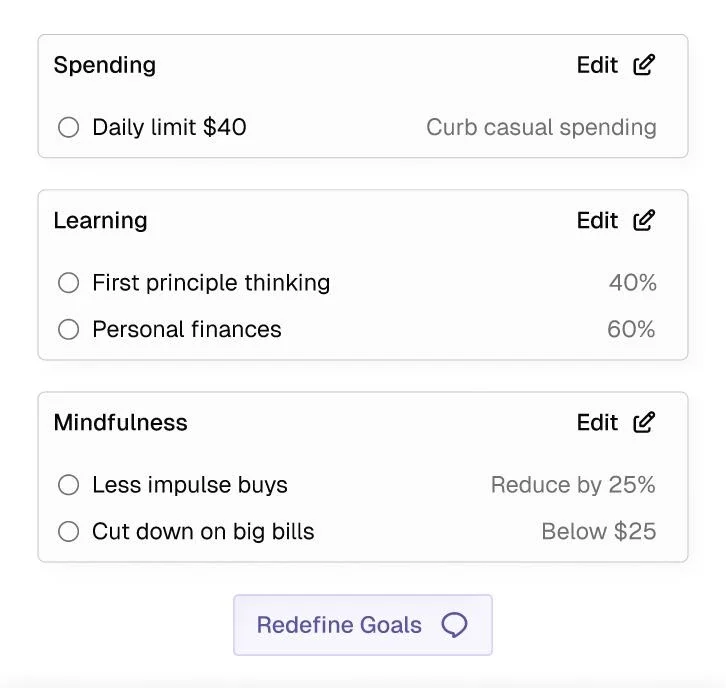
Goals are your trails.
- Pick up exactly where you left off
- A healthy mix is mandatory: spending, learning and mindfulness
- Aspiration and pain sit deep in the psyche — understand it
- Goals are meant to evolve
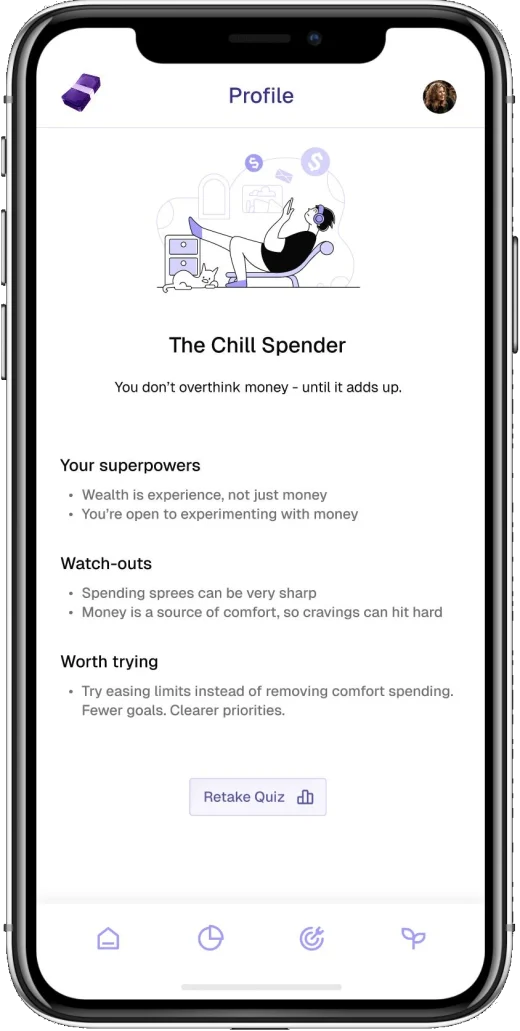
Who are you? Scientifically.
- Knowing your wealth personality helps set goals, shape learning paths and fix harmful mental models
- Know yourself: the good, the bad, and a direction forward
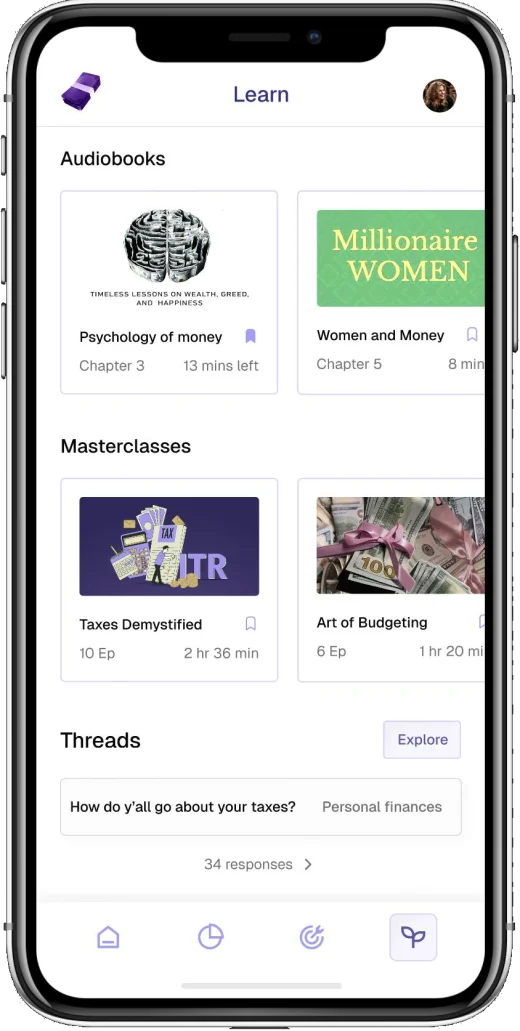
Talk wealth, think wealth.
- The more you talk, the more you know
- Content based on your profession, interests, gender and other relevant factors
- Learn from people like you, and unlike you
Business Model & Scale
How Wellth earns
B2B institutional SaaS
Annual recurring revenue paid by universities for campus licensing, as a student retention and mental wellness tool.
Hyper-local vendor marketplace
Small affiliate commissions and premium listing fees from hyper-local partners, like Joe Coffee and local grocers, to drive targeted student foot traffic.
Corporate CSR & scholarship integration
Corporate sponsors fund micro-grants directly through the platform, for a small administrative processing fee.
Partners and funders
Pioneer institutions
The New School, New York University, CUNY and Columbia University.
Vendors on Wellth
CVS Pharmacy, Joe Coffee, Trader Joe's, Ambo Food, Aldi Grocery and local delis, offering student-targeted deals.
Institutional support
University financial aid offices and student government associations, alongside behavioral science researchers and data privacy legal experts.
Data integration partners
Property management firms for seamless rent data, and secure API providers.
Funding is aimed at three groups whose goals line up with the outcomes.
Philanthropic grants
Behavioral change initiatives and financial wellbeing.
Ed-tech & impact investors
AI-driven student support and scalable campus infrastructure.
University innovation funds
Student retention solutions and graduate success outcomes.
Choosing how to scale
Three pathways were weighed against each other.
Social franchising
- How scaling works
- Package the model and AI engine into a system that university partners pay to implement.
- Benefits
- High quality control over the AI solution while leveraging existing infrastructure.
- Trade-offs
- High upfront costs to document the systems, and a slower initial pace to vet partners.
- Our view
- Keeps the integrity of the mission while ensuring B2B revenue.
Training & accreditation
- How scaling works
- Train university staff on the methodology so they receive “Accredited Wellth Institution” status.
- Benefits
- Influences the culture of financial aid offices without a massive central support body.
- Trade-offs
- Limited control over how trained staff interact with students day to day.
- Our view
- A secondary path to help shift institutional mindsets.
Government delivery
- How scaling works
- Partner with the Department of Education to integrate the engine into standard student loan portals.
- Benefits
- The widest possible reach and long-term sustainability through government budgets.
- Trade-offs
- An extremely slow process, with the risk of losing control of the experience as it becomes a compliance tool.
- Our view
- A long-term goal for ultimate systems change.
Scaling logic
University partners are the delivery arms. Wellth stays the brain.
Under social franchising, Wellth’s role shifts from direct service provider to systems orchestrator: it supplies the AI infrastructure and methodology, while universities deliver it. The rollout starts with NYU, a private college, and CUNY, a community college.
Before launch
Pre-launch
Finalize the Wellth Franchise Manual covering the AI logic and nudge library, build secure API prototypes that plug into university bursar and financial aid databases, and recruit two pilot partners to co-design the integration. Revenue: philanthropic grants, founder investment and small co-design fees.
Years 1–2
Pilot
Launch at the first 2–3 partner universities, refine predictive accuracy on real student data, tune the interface to the empowerment-over-shame principle, and stand up a quality-control team. Revenue: one-time implementation fees and initial annual licenses.
Years 3–4
Expand
Grow to 10–15 universities, launch a standardized accreditation program for university staff, automate onboarding, and begin collecting aggregate data for system-wide insight. Revenue: recurring annual licenses and accreditation fees.
Year 5 onward
Systems change
Reach 50+ institutions nationally and internationally, and use the data to advocate for policy shifts in how student aid is distributed. Revenue: tiered subscriptions for large university systems, government contracts and data insight reports for policymakers.
0,000+
students reached per institution (target)
0+
institutions at national and international scale
25–30%
of graduate students reached within target ecosystems in five years
What the funding builds
01
Build
- Core software engineering team
- AI and IP infrastructure
- Co-designed university pilots
02
Scale
- Campus licensing expansion
- Vendor and scholarship partnerships
- Scalable student support systems
03
Impact
- Reduced financial anxiety
- Increased financial confidence
- More proactive financial decisions
Measuring Impact
Impact is tracked at three levels, from what the platform does to what changes for students.
Activity — what we do
Weekly active users; financial nudges and recommendations delivered; connections made to financial support such as aid or emergency funds.
Output — what is produced
Share of users who act on recommendations; users accessing financial aid or support through the platform; average sessions per user per month.
Outcome — what changes
Increase in self-reported financial confidence; reduction in financial anxiety on standardized scales; increase in proactive versus reactive decisions.
These metrics follow the theory of change, tracking the shift from engagement with the system to confidence, lower anxiety and better long-term decisions.
The ask
Building the financial headlights for the next generation.
Related Project

Self-Project
ORIGN
A Direct-to-Artisan Marketplace & Cultural IP Platform
Mapped the four-layer ecosystem failure behind India's artisan economy, from design theft to generational decline, using the Iceberg Model
Self-Project
CareGrid
System Intervention
Accepted into the Base44 Accelerator — Top 44 worldwide