
Strategic Context
New York City holds one of the densest concentrations of universities in the world. The poster above lists more than thirty colleges and universities, from The New School, Parsons, NYU and Columbia to Pratt, Cornell Tech, Cooper Union and CUNY. Between them sit designers, engineers, strategists, artists and business students who will probably never work together.
The COL-lab (The Cross-Organizational Learning Lab, pronounced “the Collab”) is a student-led organization at The New School built to change that. It is a registered student club, and it is also an engagement engine: it creates structured sprints, hackathons and collaborative projects that pull students out of their major and into rooms with people from other disciplines and other schools, working on real problems brought by founders and organizations.
30+
colleges and universities in one city, named on the campaign poster
0 hrs
to move from a founder's brief to working prototypes
5–10
parallel solutions for a founder from a single sprint

The Problem
The gap
There is no shortage of talent. Good collaborations don't happen.
Even at a school as interdisciplinary as The New School, students spend years inside one major, one classroom, one bubble. Most “collaboration” stays surface-level. At the same time, founders have the opposite problem: real, pressing questions and no fast, affordable way to get fresh thinking on them.
Five failures sit behind it.
Hiring
Resumes and interviews don't prove real execution under pressure.
Silos
Majors and schools rarely intersect, so creative energy stays isolated.
Pace
Semester-long projects lose steam and don't match startup cycles.
Access
Students lack a low-risk arena to test bold ideas, fail and iterate.
Founders
R&D and agencies are costly, Gen-Z insight is thin, and talent scouting is high-friction.
Learning
Theory stays in the classroom
Students ship work on live challenges and build proof-of-work
Teams
Same major, same school, same bubble
A designer, an engineer and a strategist from different schools on one team
Pace
Semester-long projects
Sprints and hackathons measured in days
Hiring
Resumes and interviews
Founders watch teams build, then bookmark people directly
Founder access
Slow, expensive R&D and agencies
Fast, low-cost, unconventional thinking from outside the industry
The opportunity
What if the city itself became the lab?
The Idea
The COL-lab runs on two connected levels, set out in its constitution.
Macro: the city
City-wide collaboration with external universities, alumni, founders, organizations and professionals across technology, design, fashion, consulting, art and social innovation.
Micro: The New School
Internal collaboration that lets students from different schools and majors co-create, learn and work together inside the New School ecosystem.
At the center is one simple unit: curated rooms. A two-hour session with forty people adds up to eighty hours of thinking, and an organization can tap into all of it with one real challenge.
0 hrs
a curated room
0
people from different schools and majors
0 hrs
of collective thinking aimed at one problem
Who it serves
Students: the invisible advantage
Proof-of-work portfolios from real projects. A risk-free arena where failure carries no grade. A silent hiring pipeline that leads to job opportunities. Cross-disciplinary literacy: speaking both design and venture capital.
Founders: the multi-solution engine
Rapid prototyping, with 5–10 diverse solutions from a single weekend. Unfiltered Gen-Z insight without paying for focus groups. Low-stakes talent scouting where grit and leadership are proven in action.
Institutions: the reputation anchor
Market differentiation as an industry-integrated, live-lab school. Alumni re-engaged as active mentors. An end to isolation, putting The New School and Parsons at the center of the city's collegiate innovation network.
How It Works
A sprint, from both sides
01 · Founder
Share the challenge
- Bring a real problem: product, growth, design, operations, research or brand
- Scope the sprint in a short call
- Optionally offer a prize, stipend or internship pathway
02 · The lab
We sprint
- Cross-disciplinary teams from The New School, NYU, Columbia, Pratt and beyond
- Several independent teams tackle the same brief in parallel
- A hackathon or focused sprint format
03 · Outcome
Walk away with solutions
- Multiple concepts, prototypes or strategies
- A first look at rising design, tech and business talent
- A team member or mentor on sprint day to guide the room
01 · Student
Join a sprint
- Sign up for a hackathon built around a real founder's problem
- No prior hackathon or industry experience required
02 · Student
Team up across majors
- Get matched with students from other majors and schools across NYC
- Maximum of two teammates from the same major
03 · Student
Build, pitch, connect
- Walk away with real work, new friends and a wider network
- Work is captured and attached to a profile
Four design principles
Anti-resume
Sign in with a school email, choose five skill tags and a persona 'vibe'. Identity is built from what people can do, not where they have been.
Forced alchemy
A team rule caps teammates from the same major, so every brief is solved from several disciplines.
Proof-of-work over paperwork
Every sprint prototype is captured and attached to the student's profile as verified work.
Silent hiring
Founders watch teams build, then bookmark profiles directly. No HR funnel in between.
The New Professional
Someone who doesn't wait for an internship, but builds a career through the projects they lead while still in school.
The Platform
Alongside the club, I designed a platform prototype that runs the whole loop: briefs in, strike teams formed, work captured, talent surfaced. It has separate workspaces for students, founders and organizers, and four modules for the sprint cycle.
Student workspace
Founder workspace
Admin workspace
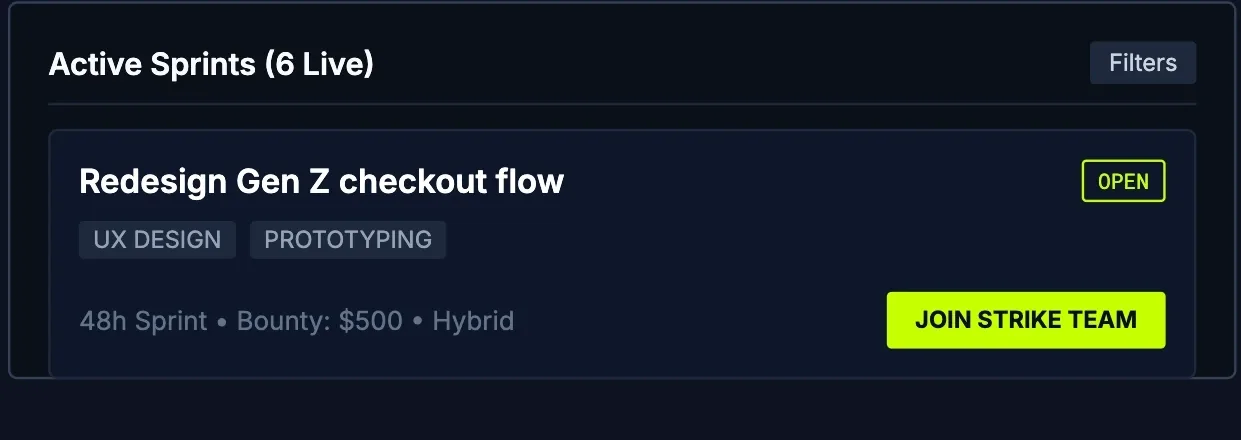
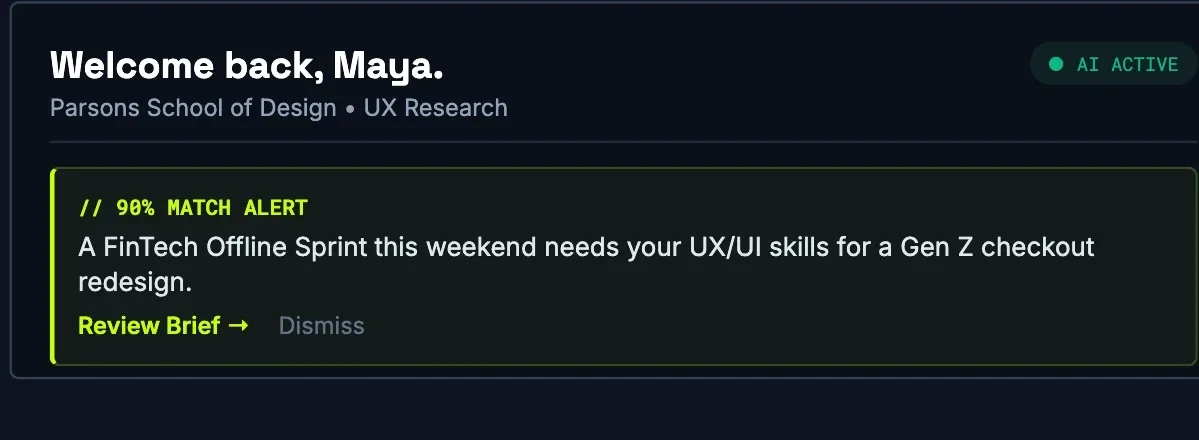
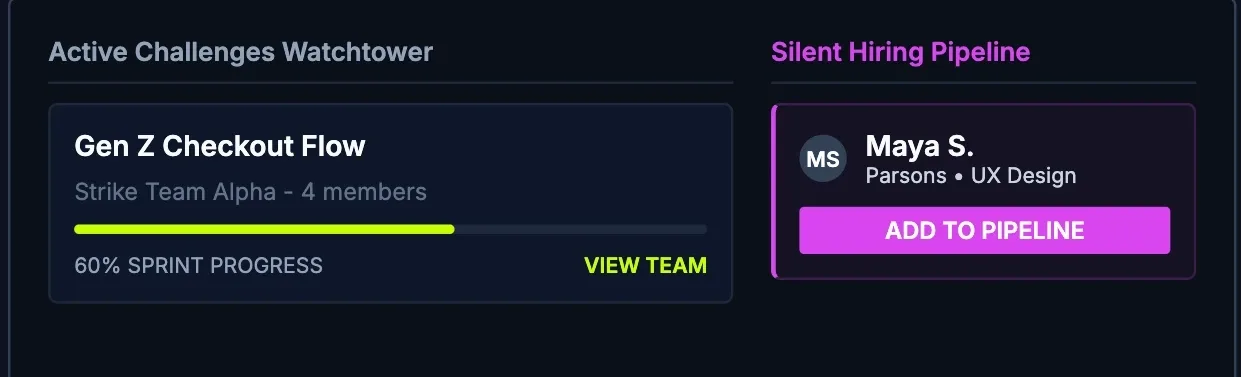
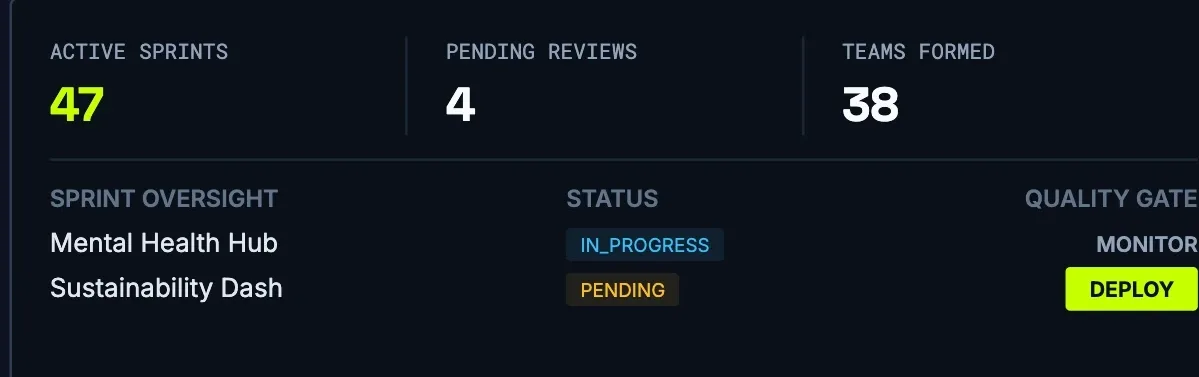
Names, counts and amounts in the screens are sample data used to show how the platform would work.
War Room
Live founder briefs for students to browse, filter and join.
Talent
A marketplace of verified, work-based student profiles for founders.
Exchange
Physical collision events across NYC. Silent hiring happens in person here, and a bookmarked student may be invited to a private coffee chat.
Lab Manual
Skill-swaps, flash workshops and alumni office hours. Hosting a session counts as proof-of-work on a student's profile.
01
No resumes
- School-email sign-in
- Five skill tags and a persona 'vibe'
02
The 90% nudge
- An AI agent routes high-fit sprints to the right talent
03
Strike team
- Interdisciplinary lock: at most two teammates from the same major
04
Proof-of-work
- Prototype is captured and attached to the profile
05
Watchtower
- Founders observe teams and harvest 5–10 prototypes
06
Quality gate
- Admins monitor, adjust matching and trigger local events
07
Silent hiring
- Founders bookmark standout students and offer credible opportunities
Building the Organization
The COL-lab is also a governed institution. Its constitution sets how it runs and keeps it open to every New School student.
Open membership
Open to all students across The New School. Staff, faculty, alumni and administrators together can make up no more than 25% of the general membership.
Executive Board
Founding officers lead partnerships, programming and finance, appointed in consultation with a Faculty Advisor. One officer serves as treasurer, and terms last one year.
Rhythm
General body meetings at least monthly during the semester and Executive Board meetings every two weeks, with annual elections once membership is established.
Accountability
Officers can be removed by a two-thirds board vote after consulting the Faculty Advisor, and any member facing removal is heard first.
Optional standing committees (External Partnerships, Events & Programming, and Research & Documentation) can be formed or dissolved by a board majority as the organization grows.
The Pitch to Organizations
For organizations, the offer comes down to one line: bring us a real challenge, and let’s explore it together. The format is flexible: sprints, hackathons, storming sessions, user research, and anything else that helps. Organizations bring a real problem, someone to brief and mentor the teams, and openness to unconventional, early-stage thinking.
Multiple independent teams
Several teams tackle the same problem in parallel, which gives founders options to compare.
Fresh outside thinking
Students who haven't yet been trained to think inside an industry's box.
Concepts in days
A fast turnaround that internal R&D and outside consultants rarely match.
Low cost, no commitment
Low-cost innovation with zero long-term commitment, plus early visibility into rising talent.
The ask
Genuine curiosity. Honest conversation.
Related Project
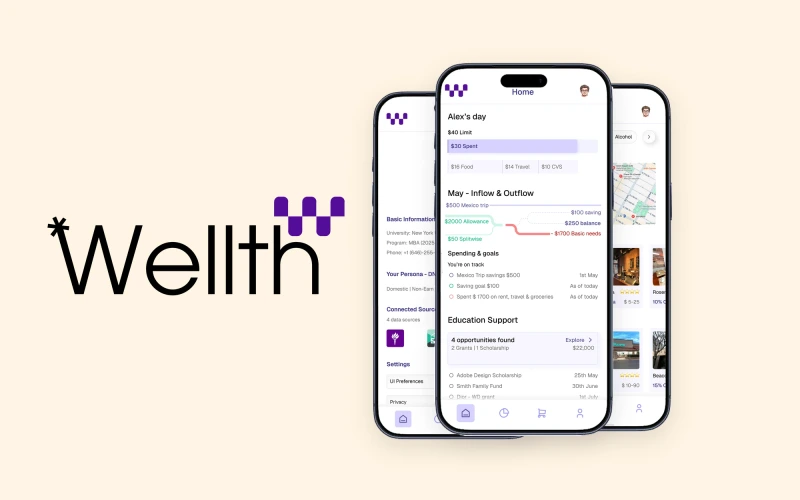
Self-Project
Wellth
AI-Enabled Financial Wellbeing for Young Adults
Mapped the reinforcing loop between financial stress, reactive decisions and lower stability through 17 interviews, 2 focus groups and 3 expert conversations
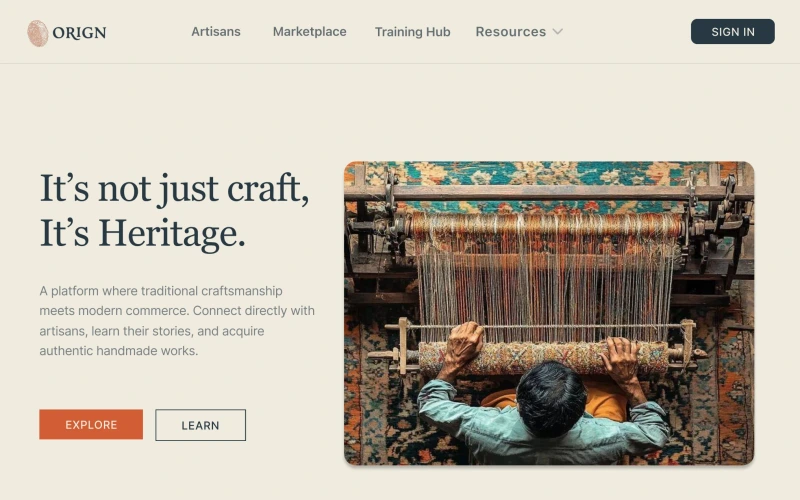
Self-Project
ORIGN
A Direct-to-Artisan Marketplace & Cultural IP Platform
Mapped the four-layer ecosystem failure behind India's artisan economy, from design theft to generational decline, using the Iceberg Model